John C. Calhoun Quotes
In its exterior relations - abroad - this government is the sole and exclusive representative of the united majesty, sovereignty, and power of the States, constituting this great and glorious Union. To the rest of the world, we are one. Neither State nor State government is known beyond our borders. Within, it is different.
Calhoun, John C. The Works of John C. Calhoun. Edited by Richard K. Crallé, vol. 4, D. Appleton and Company, 1854.

The Constitution was not drafted until 1787 and was ratified later. In the interim the young United States functioned under the Articles of Confederation, in a sense, our first Constitution. This clause established that the Federal Government should have the exclusive power and authority to conduct foreign affairs.


Even in modern times many politicians the world over agree with Davis’s point that for a government to function well, the nation must have a homogenous citizenship. This is especially true of dictatorships where control of a uniform culture and populous is easier than if it is diverse nation. In modern times, the three greatest economic and scientific powers, the United States, The Soviet Union, and China were and are multicultural societies with different ethnicities, races, religions, and cultures among their sitizenry.


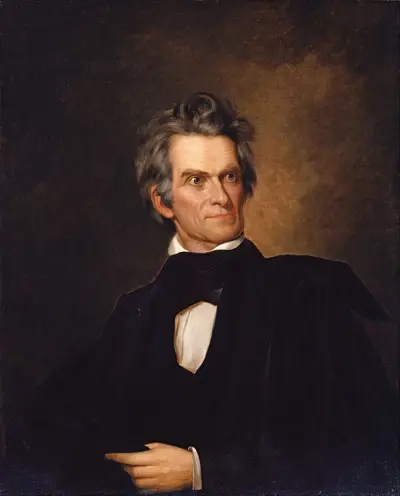
John Caldwell Calhoun was an American politician and political theorist from South Carolina who held many important positions including being the seventh vice president of the United States from 1825 to 1832, while adamantly defending slavery and protecting the interests of the white South when its residents were outnumbered by Northerners. He began his political career as a nationalist, modernizer, and proponent of a strong national government and protective tariffs. In the late 1820s, his views changed radically, and he became a leading proponent of states' rights, limited government, nullification, and opposition to high tariffs. He saw Northern acceptance of those policies as a condition of the South remaining in the Union. His beliefs and warnings heavily influenced the South's secession from the Union in 1860–1861.
