Antonin Scalia Quotes
With each decision of ours that takes from the People a question properly left to them - with each decision that is unabashedly based not on law, but on the 'reasoned judgment' of a bare majority of this Court - we move one step closer to being reminded of our impotence.
Scalia, Antonin. Dissenting opinion. Obergefell v. Hodges, 576 U.S. 644, Supreme Court of the United States, 26 June 2015.


Originally it was published in Boston under the name “A Columbian Patriot.” She was worried about the jurisdiction of the Supreme Court extending throughout the country and yet the nation was very much smaller then than it is today. However, transport and communications have grown with the country.


This surprising quote of Roosevelt’s is noteworthy for two reasons. First most of us are amazed that one of our greatest presidents were opposed to the Checks and Balances of the Constitution as it has been interpreted since Chief Justice Marshall and his Court asserted the power of Judicial Review. Second, at the beginning of the 21st century the Republicans / Conservatives opposed the power of the Supreme Court and wanted it diminished, while the Democrats were strong supporters of judicial review. In TR’s era, the parties were flip flopped. It was William Jennings Brian and the Democrats who wanted to curtail the power of the court (they had then found even the income tax unconstitutional), while the Republicans / Conservatives fought to uphold the “traditional” role of the Supreme Court. Roosevelt, not only sided with the Democrats against his own party, but went further than Bryan or any other Democrat in calling for the voter’s right to review and nullify Supreme Court Decisions that were unpopular. Needless to say, most of TR’s Republican compatriots were not happy with him, but that was not uncommon as he took on the trusts and monopolies, set up national parks, established Federal Regulation of Food, and other positions that out reformed the Democrats.


This quotation is historically important because Davis clearly states the reason for the rebellion of the South. The anti-slave states were growing at a greater rate than the slave states and despite the greater voting power that a southerner had (a result of the 3/5 count of slaves for census purposes, and the Senate), the handwriting was on the wall and the majority of the United States was against the vicious institution of slavery and would make it unprofitable, impossible and/or illegal in the coming years. Southern slavery advocates saw this as a “tyranny of the majority” and therefore took up arms. In the early 20th century, apologists for the Southern rebellion tried to promote the idea that there were reasons other than slavery, but this quotation and the resolutions of the states who withdrew from the Union make it clear that the right to maintain slavery was the only significant issue. In that sense it was a States’ Rights issue, but the South was opposed to States’ Rights when it came to States refusing to return fugitive slaves when Federal Law required such under the Dred Scott Supreme Court Decision.


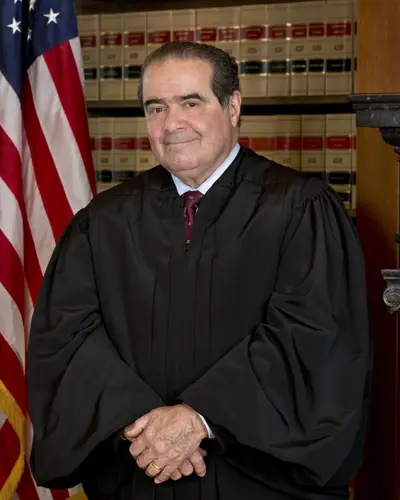
Antonin Gregory Scalia was an American jurist who served as an associate justice of the Supreme Court of the United States from 1986 until his death in 2016. He was described as the intellectual anchor for the originalist and textualist position in the Court's conservative wing. For catalyzing an originalist and textualist movement in American law, he has been described as one of the most influential jurists of the twentieth century, and one of the most important justices in the Supreme Court's history. Scalia was posthumously awarded the Presidential Medal of Freedom in 2018 by President Donald Trump, and the Antonin Scalia Law School at George Mason University was named in his honor.
