Ralph Ellison Quotes
White people must know that they are part black; Black people must know that they are part white.
Ralph Ellison, 1914-1994, Writer, Quoted by Ellison biographer, Arnold Rampersad, C-SPAN, Book TV, May 3, 2007
Sourced by: Eigen's Political and Historical Quotations


This was written even before the end of slavery.


This quotation illustrates one of the earliest major political dirty tricks. The pamphlet was published supposedly as a Republican campaign piece. The Democratic ploy was to turn votes from Abraham Lincoln to the Democratic candidate, George B. Mclellan. It also appears to be the first English usage of the word “miscegenation”. Lincoln was re-elected in spite of the Republicans being portrayed as radical race mixers.

Bilbo was one of the worst racists who ever served in the Congress.

Lieber was assigned by President Lincoln to study the then international laws of war and prepare a manual for the guidance of union troops in the Civil War. Lincoln then issued the document as a general order. This statement was critical in inhibiting the South from making good on their threat to enslave any Black Union Soldier Captured and to execute any Union Black soldier who was a runaway slave from the South. Lincoln threatened to retaliate and also to hold senior Confederate officers accountable for following these rules. General Sherman and other Union Senior Officers executed a few Confederate soldiers who violated rules of the order and the “illegal” practices stopped, and with few exceptions the senior officers of both sides followed Lieber’s rules. These rules, with few modifications, governed U. S. military policies and rules through the Second World War.
Rowan was primarily referring to the miscegenation that took place since Negro slavery in the Americas. Rape of slaves by white “masters” and their male relatives was common. In addition there have been interracial romantic relationships from the time Blacks were first in America. These have increased dramatically in the 20th and 21st centuries. However, he was slightly in error as he did not consider the origin of man, where science has traced the DNA of EVERY human on Earth back to a Black African female. Hence 100 percent of humans have “Negroid” blood in the sense that there has been inter-racial breeding in the past.

This was surprising for a man who owned slaves all his life.


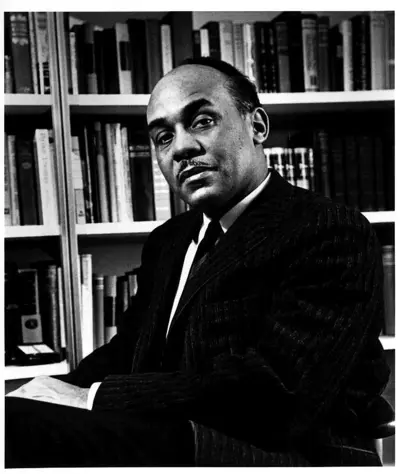
Ralph Waldo Ellison was an African-American novelist, literary critic, and scholar best known for his novel Invisible Man, which won the National Book Award in 1953. He also wrote Shadow and Act (1964), a collection of political, social and critical essays, and Going to the Territory (1986). For The New York Times, the best of these essays in addition to the novel put him "among the gods of America's literary Parnassus." A posthumous novel, Juneteenth, was published after being assembled from voluminous notes he left upon his death.
