Carter G. Woodson Quotes
White men ashamed of the planters who [sexually] abused helpless black women [slaves] are now trying to minimize the prevalence of this custom. Such an effort, however, means little in the face of the facts that one seventh of the Negroes in the United States had in their veins any amount of Caucasian blood in 1860 and according to the last census more than one fifth of them have this infusion
Carter G. Woodson, 1875-1950, Historian & Socialist, Journal of Negro History, October 1918
Sourced by: Eigen's Political and Historical Quotations

Sexual abuse of female slaves was very common in the American South. See {642027} and {642028}. In the 1930s over 2,300 formerly enslaved African Americans were interviewed by members of the Federal Writers' Project, a New Deal agency in the Works Progress Administration (WPA) during the Great Depression. This particular abuse was one of the most common reported. Ironically, the Southern justification for segregation and prohibition of inter-marriage even through the 1950s, was to prevent the great “crime” of miscegenation which white slave owners and their male friends committed by raping and sexually exploiting the female slaves. Today, as DNA analysis shows, most traditional Southern “white” families have recent Negroes in their ancestry.


This was the first time that a President had met with a group of Blacks at the White House.


This is an example of how values in politics can get complex. Family Leader put together The Marriage Vow, a pledge it wanted political candidates to sign. The pledge dealt with marital fidelity and other traditional family values. Two Republican Presidential Nomination Candidates signed the pledge rapidly as many of their competitors had notorious affairs and/or had been divorced. The 2 signers thought that they would obtain a substantial advantage. However, another part of the pledge was dealing with the importance of children being brought up in a 2 parent home, The quotation gives their statement on Black families and illegitimacy. However, they organization was so hung up on the evil of children in single parent households, that they said in the pledge that Blacks were better off under slavery than they are under Barack Obama—the first Black President. As might have been expected, there were no Blacks and even very few racist whites who would claim Black children and families were better off under slavery. They two politicians, Michelle Bachman and Rick Santorum—neither very sensitive to minority issues and perceived by most Blacks as racists—began to back away from their signing, First Leader, then removed the quoted paragraph from all copies of the signed pledges and removed it from their website. However, original copies—including the quoted paragraph—got into the hands of the media and the scandal began. Family Leader, trying to do damage control, wisely apologized. The other Republican Presidential aspirants both monogamous and otherwise, refused to sign but what it is that made them refuse was probably different for each person.
This quotation was a the description of the nail manufacturing operation using slave labor on Thomas Jefferson’s plantation, Monticello. Note the almost romantic scene that the author paints of slavery and forced child labor. That is why this is a very important quotation. This biography of Jefferson, written for a young audience, was typical of material written about the South and slavery from the late 19th century till the late 20th century. The South was still resentful about losing the war, and there was still, late in the 19th century, negative feelings in the rest of the nation about the South’s lack of patriotism and worse their basic morality of having not only supported but fought to maintain the cruel, evil institution of slavery. Many wanted to get these sectional feelings behind them and move forward. One way was to do much revisionist history about the institution of slavery and the reasons for the Civil war. Books, plays, and later films, and the school curricula, were designed to edit out or minimize the brutality and cruelty of slavery. And the reasons for the Southern rebellion was not any longer only to maintain slavery, but more palatable, almost noble reasons were substituted for the reality that slavery was the only major reason for the Southern rebellion. Maintaining a different culture and way of life, freedom from Federal intrusion in state and local affairs, honor and others were then new given reasons, and the problems of Reconstruction for the South exaggerated to justify the then Jim Crow American era of legal discrimination and lynching. This passage came from a book that was so popular with young people, that it was published again in a new edition as late as 1961. Most white Americans, growing up in the 20th century learned this version of events and many vestiges of it could be seen, even in the 21st century. In the 1970s, with an end to legal segregation, attention turned to the culturally and historically distorted views, and slowly schools began to change curricula. However, in the Southern States, in order to prevent the schools from departing from the false, romantic view of Southern Slavery, local schools where not allowed to select their own textbooks and in many cases even their own library books.

3rd Earl Russell of Kingston. This is a wonderful example of scientific thinking about a politically and emotionally charged subject.

While this assessment was true up until the 1980s. By the 21st century there were almost no serious historians who thought that the motivation of the Confederate States for the Civil War was anything but slavery and the economic impact that abolition might bring. However, one of your advantages having this collection of historical quotations is that you can see for yourself why the Southern states say they were seceding. This following are four of the official secession resolution documents. Read these and you will see that all the claims that there were other major reasons for secession are just attempts to make the Confederacy a little less brutal and greedy. See {621371}, {619793}, {621372}, {621375}
Rowan was primarily referring to the miscegenation that took place since Negro slavery in the Americas. Rape of slaves by white “masters” and their male relatives was common. In addition there have been interracial romantic relationships from the time Blacks were first in America. These have increased dramatically in the 20th and 21st centuries. However, he was slightly in error as he did not consider the origin of man, where science has traced the DNA of EVERY human on Earth back to a Black African female. Hence 100 percent of humans have “Negroid” blood in the sense that there has been inter-racial breeding in the past.

This idea has been rejected by American Blacks from before the Civil War. There were many Black families that have been in America longer than Rockwell who always had the choice to go back to where they cam from if they were unhappy with America but they never did.

Thirty young black men and women carrying pistols, revolvers, and shotguns, appeared at the grand entrance of the California Capitol Building. The capital police stopped them and asked what they were going to do with their guns. Bobby Seal replied by asking the police officer what he was going to do with his gun. Seale led his overtly armed followers inside while police and legislators looked on in horror. They were breaking no law. See linked quote.

He was a deeply religious Christian which is one of the reasons that he was appointed to head the Freemen’s Bureau to integrate the emancipated slaves into society. Howard University was named for him, and he served as its First President. For more about the Bureau. See {629185}.and {629187}.

For more about the Bureau. See {629185}.and {629187}.
For more about the Bureau. See {629186} and {629187}.

Brigham Young, the Mormon Leader and Territorial Governor, was strongly opposed to Interracial sex. See {629150}. An earlier clause provided for loss of the rights to a slave if the master had sexual relations with the slave, something that no Southern State had ever done.

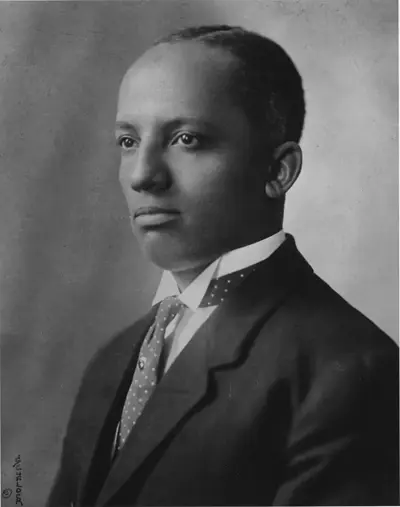
Carter Godwin Woodson was an American historian, author, journalist, and the founder of the Association for the Study of African American Life and History. He was one of the first scholars to study the history of the African diaspora, including African-American history. A founder of The Journal of Negro History in 1916, Woodson has been called the "father of black history". In February 1926 he launched the celebration of "Negro History Week", the precursor of Black History Month.
