Rutherford B. Hayes Quotes
Where matters of dispute are made the subject of arbitration under the forms of law. Human judgment is never unerring, and is rarely regarded as otherwise than wrong by the unsuccessful party in the contest.
Rutherford B. Hayes, 1822-1893, 19th President of the United States (Republican, OH), Inaugural Address, March 5, 1877
Sourced by: Eigen's Political and Historical Quotations


Manava Dharma Shastra. Here is a type of Freedom of Information Act in Ancient India. This text is a part of the Hindu Holy Texts. Hindus believe that Manu was a prophet whose text is revealed or inspired.

This is one of the earliest American articulation of the 12 man jury.

Treaties often end up with disputes of the parties over issues in the treaty. Good treaties have built in a method for resolving differences regarding the treaty. This clause is a good example.

Islam was not very strong at this point and the followers of Muhammad were relatively few and Medina area contained Arab Non-Believers, Jews as well as the new Muslims. Muhammad drew up this document and got the non Muslims to agree to it. What is fascinating is that they bought into the idea that Muhammad would be the judge and final arbitrator of all disputes that were not resolved locally. The non Muslims agreed to this because Muhammad had been judging disputes for several years for those who would submit their cases to them. In a time of inconsistency, corruption, capriciousness and arbitrariness, Muhammad had developed a remarkable reputation for fairness, consistency, objectivity, and complete honesty. He could not be bought as most judges were at the time. He simply had demonstrated that he was the best man for the job.

Some democratic cultures are very distrustful of government bureaucracies and prefer to resolve conflicts through the courts where the process in in general much more transparent. The U. S. is not the only example. Israel is even more litigious.


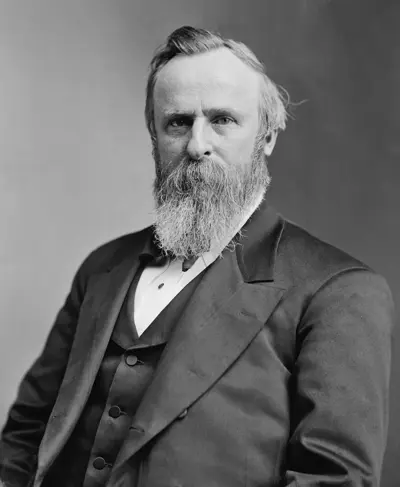
Rutherford Birchard Hayes was an American politician and attorney who served as the 19th president of the United States from 1877 to 1881, after serving in the U.S. House of Representatives and as governor of Ohio. A lawyer and staunch abolitionist, he had defended refugee slaves in court proceedings during the antebellum years. He negotiated the political agreement to end federal support of Reconstruction.
