Ko Wen-je Quotes
When we understand and respect Beijing's insistence on some aspects, we hope Beijing can understand and respect Taiwan's insistence on democracy and freedom.
Chung, Jake. "Ko reiterates 'one family' cross-strait policy." Taipei Times, 4 July 2017, p. 3.


This Proclamation was issued upon arrival of the British occupying imperial army in present day Iraq. The English policy makers like the Bush administration almost a century later were expecting a more welcoming reaction. See {585250}.

See {585494},65902, and {585496}, for more quotations on this.

When whites first came to America, the Iroquois, were the most sophisticated Native Americans. They were actually a confederation of 5 different tribes each of which was composed if many clans. Although fierce warriors, they had agreed not to fight each other and to assist if any were attacked. They developed a strong agricultural base, to go with the fishing and hunting, and their confederation were very aggressive and sophisticated traders taking them far from their upstate New York “capitol.” Their governmental structure was quite sophisticated with an elaborate, formal, system of checks and balances, multi-cameral legislatures that recognized numbers of citizens, power and wealth, and even cultural traditions. They were literate, capitalistic and globalistic in that they wanted to trade with all. They had written laws, and women had a role that was unique in world history in that only women owned property in a matrilineal society. Further, it was only the Clan Mothers who voted for the 50 Sachems (~Senators)—but their selections had to be accepted by the people they represented. Ironically the descendants of the Iroquois who remained in New York became a very successful Native American group. In the 2000 census, the average Indian in New York State earned the same income as the average White with no Indian gambling money.

American Presidents after Wilson have not, in general, shared this view. By the latter part of the 20th century judgmentalism was a major component of American foreign policy and reached its zenith with the administration of George W. Bush.


This quotation illustrates a huge reversal of policy. When Chiang Kai-shek and the Nationalists were defeated by the Communist Chinese in the Civil War, the Nationalists retreated to the island of Formosa (Taiwan) which was the only Chinese Province they held. There was the thought of setting up a separate nation on Taiwan, but Chiang Kai-shek and the Nationalists insisted that there was only one China and that they were the rightful government. At the time they held the Chinese UN Seat. The Communists also insisted that there was one China and Taiwan was a part of it with the Nationalists there being rebels. Chiang Kai-shek maintained that the people really wanted the Nationalists and they could take back the mainland. That turned out to be unrealistic and then the UN seat was given to the Communists as they were the de facto government of all of China except the province of Taiwan. There was nothing that the Nationalists and Communists agreed upon except that there was one China and Taiwan was a part of it. That, and the request of the Nationalist Chinese, has been the U. S Policy for decades. However by the 21st century, it was clear, even to the most fervent Nationalists, the Chinese Communists had won the allegiance of the majority of the Chinese people and they were not going to be successful in mounting a counter-revolution. Moreover, the Communist Military was much superior and some of the Nationalists started worry that Taiwan would be governed by the Communists along with the rest of China, So Lu and other Nationalists, flip flopped and took the position that Taiwan was an independent country—a view that is not recognized by the U. S. or China.
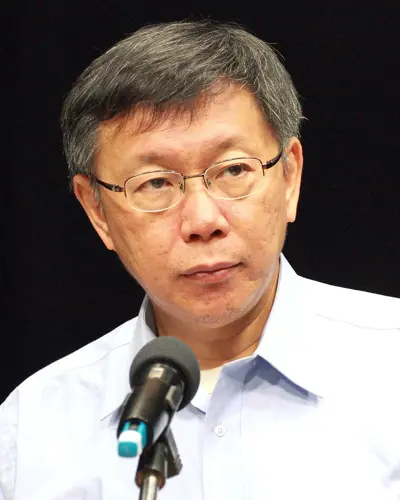
Ko Wen-je, also known by his nickname Ko P (Chinese: 柯P; pinyin: Kē Pī; Pe̍h-ōe-jī: Koa Phi), is a Taiwanese politician and physician. Ko has served as mayor of Taipei since 2014 and Chairman of the Taiwan People's Party since 2019. Before becoming the mayor, he was a doctor at the National Taiwan University Hospital. He was also a professor at National Taiwan University College of Medicine and specializes in trauma, intensive care, organ transplant, extracorporeal membrane oxygenation (ECMO), and artificial organs among others. Due to his profession, he has been nicknamed Ko P or KP (which stands for Professor Ko, and is how he is customarily referred to within National Taiwan University). Ko was responsible for standardising organ transplant procedures in Taiwan, and was the first physician to bring ECMO to Taiwan. Apart from his practice, Ko is known for his numerous media appearances and interviews as a social and political commentator.
