Akbar Ahmed Quotes
When societies feel under siege there is limited scope for understanding or compassion.
Akbar Ahmed, Islamic Scholar, Testimony, Senate Foreign Relations Committee Hearing: Islam & The West, July 18, 2006
Sourced by: Eigen's Political and Historical Quotations


In September of 2005 a Danish Newspaper published some political cartoons showing the hypocrisy of some Muslims who use Islam to justify murder of innocents and terrorism. Months later, in January of 2006 many in the Middle East protested vehemently and Muslim fatal riots broke out because the Prophet Muhammad's visage was depicted against Islamic tradition. Many Muslim nations started a boycott against Denmark. Many Muslim leaders claimed that insulting religion was an “abuse” of freedom of speech including those from nations which regularly publish material that is virulent against Christians and Jews

Terrorism is not new to Islam. It was proscribed by the Prophet when fighting the “enemies of Allah.” There are those who believe that he was not advocating terrorism as we know that term today. Instead they believe that he meant that they should scare and intimidate the enemies of God, and the sura does not explicitly promote or sanction the murder of innocent civilians. They would interpret this quotation to mean “Attack the military enemies of God so severely that they well fear you and be intimidated.” Others see the quotation as an explicit endorsement of terrorism. What better than beheading or exploding random members of a society that is opposing Islam and Allah in order to “strike terror into the hearts of the enemies of Allah.”


One of the strong motivations of Islamic terrorists is the fact that they believe that a Muslim who dies fighting for Islam goes immediately to Paradise. However, terrorists create Hell for innocent civilians and people who have no desire to harm Islam—in many cases babies and young children who do not even know what religion is. While this statement represents the beliefs of most moderate Muslims, it was made after he was out of office. It is doubtful that an Iranian President—a position without much power in the Iranian theocracy where the religious leader rules—in office would dare say something like this when Iran supports Islamic terrorist organizations throughout the world.

This quotation is often given by those who believe that nothing has really changed regarding the Arabs and non-Islamic Westerners in the last century. While the support of dictators, Israel and support for that democracy, the artificial Western imposed borders, 9-11, or the Iraq war is often cited as the cause of Arab hostility and murderous aggression, as this quotation demonstrates, the problems and attitudes and behaviors existed long before any of these occurred. The borders were not set until after WWI and all the other causes occurred almost 50 years later, Yet there was still the propensity for fanaticism and violence. Sikes actually was one of those who was to determine the Arab borders, making one of the first “suggested” maps of the area for the English.

This is one of the quotations from the Koran which many Islamic terrorists point to in order to morally justify terrorism. For an example, see {586965}.


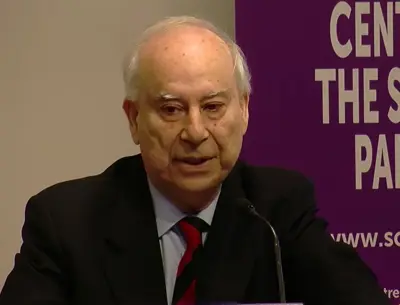
Akbar Salahuddin Ahmed, is a Pakistani-American academic, author, poet, playwright, filmmaker and former diplomat. He currently holds the Ibn Khaldun Chair of Islamic Studies and is Professor of International Relations at the American University in Washington, D.C. A former Pakistani High Commissioner to the UK and Ireland, Ahmed was a member of the Civil Service of Pakistan and served as Political Agent in South Waziristan Agency and Commissioner in Baluchistan. He also served as the Iqbal Fellow (Chair of Pakistan Studies) at the University of Cambridge as well as holding teaching positions at Harvard, Princeton, and the U.S. Naval Academy. An anthropologist and scholar of Islam, he received his PhD from the School of Oriental and African Studies in London. He has been called "the world's leading authority on contemporary Islam" by the BBC.
