Peter G. Peterson Quotes
When in crisis did government get smaller?
Peter G. Peterson, U. S. Secretary of Commerce, Speech, Institute for International Economics, August 9, 2004
Sourced by: Eigen's Political and Historical Quotations


Goldwater was the first Republican Presidential Candidate since the end of WWII who had campaigned for smaller government and reduced government spending. He actually started the modern Republican trend toward campaigning on this theme. Ronald Reagan did a much better job of campaigning on this theme, and all Republican Candidates since have campaigned on these two themes. It is not clear whether the Republicans were actually serious about this or just ran on the themes to please the political wing that Goldwater had started or meant it but were not good enough at running the government to fulfill this promise. Every Republican President from Reagan through George W. Bush increased the government spending and increased the number of government employees—more so than most Democrats ironically. Democratic President Bill Clinton was the only post WWII president to cut spending, produce a surplus and diminish the size of the government bureaucracy. Goldwater was so intellectually honest that had he won, he probably would have done everything he could to implement the policy of smaller government and less spending.


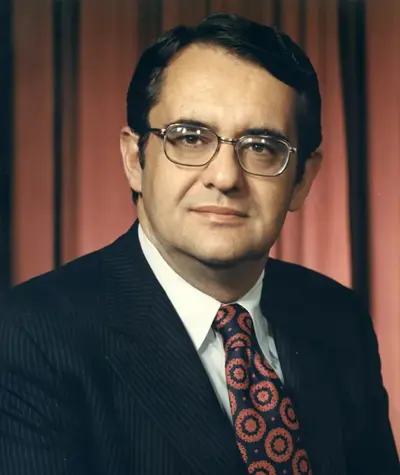
Peter George Peterson was an American investment banker who served as United States Secretary of Commerce from February 29, 1972, to February 1, 1973, under the Richard Nixon administration. Before serving as Secretary of Commerce, Peterson was also chairman and CEO of Bell & Howell from 1963 to 1971. From 1973 to 1984 he was chairman and CEO of Lehman Brothers. Later in 1985, he co-founded the private equity firm The Blackstone Group, and served as chairman. In the same year, Peterson became chairman of the Council on Foreign Relations, a position he held until his retirement in 2007 after which he was named chairman emeritus. In 2008, Peterson was ranked 149th on the "Forbes 400 Richest Americans" with a net worth of $2.8 billion. He was also known as founder and principal funder of The Peter G. Peterson Foundation, which is dedicated to promoting fiscal austerity.
