Leo Tolstoy Quotes
When I have one foot in the grave, I will tell the whole truth about women. I shall tell it, jump into my coffin, pull the lid over me and say, "Do what you like now."
Gorky, Maxim. Reminiscences of Leo Nikolaevich Tolstoy. Translated by S. S. Koteliansky and Leonard Woolf, B. W. Huebsch, 1920, p. 73.


This proverb doesn’t mean quite what it would appear to—that women will never be attacked in an act of revenge. It does mean that when relatives are selected for vengeance killing, or other acts of vengeance, women will not be selected. However in one tragic Pakistani case in 2003, a Muslim man had purportedly had an affair with a woman from another clan. That clan’s male relatives took revenge. A group of them gang raped a sister of the man who purportedly had committed the offense. The “logic” was that by raping the woman, they were destroying the honor of the brother’s family as they in their perception had had their family’s honor destroyed. The fact that it was the innocent woman who was brutalized didn’t enter into the equation—there was no direct intent to take vengeance on her; it was taken on her male relatives. Worse was the fact that a local “tribal court” had authorized the action as a “legal” act of “blood” or vengeance. The national government, embarrassed before the world, provided minor punishments to the rapists (death might have been a rapists penalty) and then honored the woman by naming a school after her. Unfortunately the family’s honor was destroyed and marriage for the woman was unlikely in that society. In addition to the great improvements and benefits brought to half the known world by the Islamic expansion out of Arabia, many of the less desirable Arab traditions went with them informally and formally as Sharia—Islamic Law.


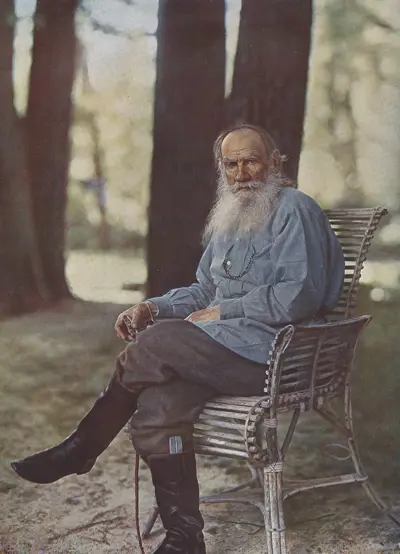
Count Lev Nikolayevich Tolstoy, 9 September, 1828 – 20 November, 1910), usually referred to in English as Leo Tolstoy, was a Russian writer who is regarded as one of the greatest authors of all time. He received nominations for the Nobel Prize in Literature every year from 1902 to 1906 and for the Nobel Peace Prize in 1901, 1902, and 1909. That he never won is a major controversy.
