Niccolo Machiavelli Quotes
Being rapacious and arrogating subject's goods and women is what above all else ... renders the Prince hateful ... and leaves a mind obstinate to vengeance.
Niccolo Machiavelli, 1469-1527, Florentine Statesman & Political Philosopher, The Prince, 1532
Sourced by: Eigen's Political and Historical Quotations

The Pope was justifying his earlier excommunication of Holy Roman Emperor Henry IV who in turn excommunicated Pope Gregory.


The sexual exploitation of female slaves by the slave owner and/or his relatives was a phenomenon about which most Southerners were in denial. Light skinned and even white babies, born to Negro slaves was fairly common. The gross immorality was so great that it was too painful for most Southerners – especially white females to even contemplate much less discuss. At the same time, the abolitionists had to be very careful that to raise this problem as delicately as possible lest the lost their audience with such gross and indelicate behavior. This quotation was particularly artfully phrased.

The Lockout was a major industrial dispute between approximately 20,000 workers and 300 employers which took place in Ireland's capital city of Dublin. The dispute lasted from August 1913 to January 1914, and is often viewed as the most severe and significant industrial dispute in Irish history. The Employers Association, intent on breaking the Unions, told workers that if they did not resign from the Union, they would be fired. With the exception of the Guinness company, all the major employers fired most of their employees and brought in scab labor from England. The Union workers and their families were starving and only food from English labor unions kept them alive. The workers finally had to give in and for signing pledges to refrain from joining unions, they were allowed to have their jobs back. Although it seemed a victory for the employers, as this letter explained, the price was paid for years thereafter and soured Irish labor relations for most of the 20th century. While the locked out workers were both Protestants and Catholics, the Irish Catholic Church sided with the employers and even opposed a plan whereby children of Irish strikers would be temporarily looked after by British trade unionists in England, Scotland & Wales. The church protested that Catholic children would be subject to Protestant or atheist influences when in Britain.


Chile with help from San Martin had ejected the Spanish. O’Higgins, the Chilean leader had joined up with San Martin and served under his command. The sectional rivalry bothered men like Carrera. Instead of seeing all the South Americans fighting the Spanish as allies as O’Higgins did, Carrera and his brothers refused to join a government of unity and they and their troops were just as dictatorial and cruel as the Spanish had been. O’Higgins gave Indians and Blacks equal rights with whites which distressed the aristocratic Carrera’s. Finally the Carrera’s tried to set up their own government, and the new Chilean government disarmed their militia and executed two of the three Carrera brothers who were leading the militia troops who were little more than thieves and brigands.

This is a variation of the famous Lord Acton quotation: {292904}.

While many of the Indian wars were over land or were defensive in nature, the major motivation for some wars with Indians was pure greed in that captured Indians were sold as slaves.


He was expelled from Parliament for such.
This proverb doesn’t mean quite what it would appear to—that women will never be attacked in an act of revenge. It does mean that when relatives are selected for vengeance killing, or other acts of vengeance, women will not be selected. However in one tragic Pakistani case in 2003, a Muslim man had purportedly had an affair with a woman from another clan. That clan’s male relatives took revenge. A group of them gang raped a sister of the man who purportedly had committed the offense. The “logic” was that by raping the woman, they were destroying the honor of the brother’s family as they in their perception had had their family’s honor destroyed. The fact that it was the innocent woman who was brutalized didn’t enter into the equation—there was no direct intent to take vengeance on her; it was taken on her male relatives. Worse was the fact that a local “tribal court” had authorized the action as a “legal” act of “blood” or vengeance. The national government, embarrassed before the world, provided minor punishments to the rapists (death might have been a rapists penalty) and then honored the woman by naming a school after her. Unfortunately the family’s honor was destroyed and marriage for the woman was unlikely in that society. In addition to the great improvements and benefits brought to half the known world by the Islamic expansion out of Arabia, many of the less desirable Arab traditions went with them informally and formally as Sharia—Islamic Law.


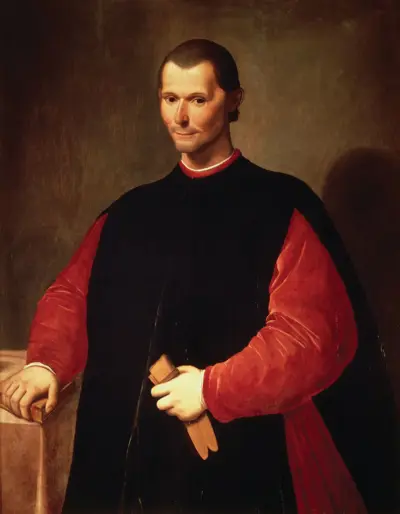
Niccolò di Bernardo dei Machiavelli was an Italian Renaissance diplomat, philosopher and writer, best known for The Prince (Il Principe), written in 1513. He has often been called the father of modern political philosophy and political science.
