Milton Friedman Quotes
When a private enterprise fails, it is closed down; when a government enterprise fails, it is expanded. Isn't that exactly what's been happening with drugs?
Friedman, Milton. Interview by Randy Paige. America's Drug Forum, 1991.


He was discussion the role of the media in terms of psychological national security in the wake of the September 11 attack.

Owner of one of the only 2 Mexican Television Networks. Pemex is the only oil company in the world, government or private, that loses money.


The first part of this quotation has defined the attitude of most Americans towards private enterprise and government since then. The second part of the quotation—the undesirability of public ownership of railroads has given way to the modern problem that no passenger railroad can be operated profitably by anyone—private or public. So Roosevelt’s “far-reaching disaster” was finally complete with the Federal Government taking over responsibility for Amtrack.

Churchill and Labor Leader Clement Attlee found themselves at adjoining urinals during a break in a political event.

There are many who think his points apply equally well to America.

This is a very interesting quotation in that right wing parties are usually opposed to any kind of Government ownership and control of business and industry. However, Fascist parties have usually wanted to commandeer business and industry for the central purposes of the dictatorial state. The French National Front Party had its roots in the WWII French Vichy Government—which was allied with the Nazis to bring Fascism and racism to France.


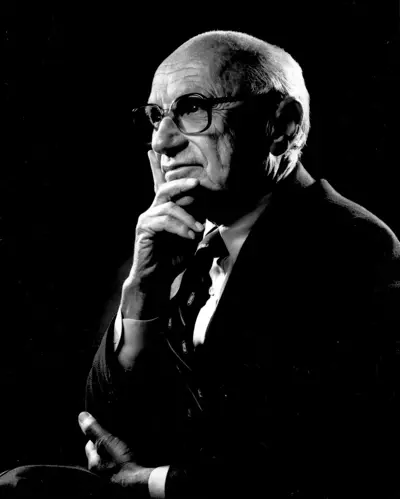
Milton Friedman was an American economist and statistician who received the 1976 Nobel Memorial Prize in Economic Sciences for his research on consumption analysis, monetary history and theory and the complexity of stabilization policy. With George Stigler and others, Friedman was among the intellectual leaders of the Chicago school of economics, a neoclassical school of economic thought associated with the work of the faculty at the University of Chicago that rejected Keynesianism in favor of monetarism until the mid-1970s, when it turned to new classical macroeconomics heavily based on the concept of rational expectations. Several students and young professors who were recruited or mentored by Friedman at Chicago went on to become leading economists, including Gary Becker, Robert Fogel, Thomas Sowell and Robert Lucas Jr.
