Pontius Pilate Quotes
What will ye then that I shall do unto him whom ye call the King of the Jews?
The Bible. Authorized King James Version, Oxford UP, 1998, Mark 15:12.


Manava Dharma Shastra. This text is a part of the Hindu Holy Texts. Hindus believe that Manu was a prophet whose text is revealed or inspired.

Quoted in somewhat different form by Richard Nixon


Manava Dharma Shastra. This text is a part of the Hindu Holy Texts. Hindus believe that Manu was a prophet whose text is revealed or inspired.


Samuel Langhorne Clemens, 1835-1910

This quotation is of historical significance because it is a source, in addition to the Bible, about the fact that the kingdom of Israel existed and was in conflict with the Moabites. Politically it is important currently because a few of the modern Arab leaders have claimed that there was never a Jewish Kingdom in the region and therefore the Jews do not have a claim on any of the land of Palestine. This is strong evidence that they are wrong. Omri was the 6th King of Israel and his son, Ahab, the 7th. A stele is an ancient stone with writing carved on it. The picture is of the Mesha Stele which today is in the Louvre Museum in Paris.
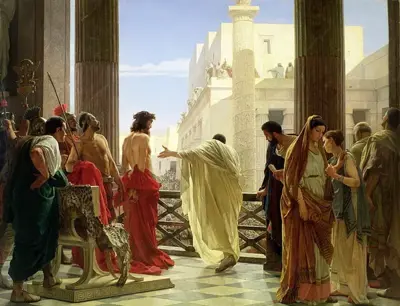
Pontius Pilate (Latin: Pontius Pilatus [ˈpɔntɪ.ʊs piːˈlaːtʊs]; Greek: Πόντιος Πιλάτος, Póntios Pilátos) was the fifth governor of the Roman province of Judaea, serving under Emperor Tiberius from the year 26/27 to 36/37 AD. He is best known today for being the official who presided over the trial of Jesus and later ordered his crucifixion. Pilate's importance in modern Christianity is underscored by his prominent place in both the Apostles' and Nicene Creeds. Due to the Gospels' portrayal of Pilate as reluctant to execute Jesus, the Ethiopian Church believes that Pilate became a Christian and venerates him as a martyr and saint.
