Voltaire Quotes
What we find in books is like the fire in our hearths. We fetch it from our neighbors, we kindle it at home, we communicate it to others, and it becomes the property of all.
There was the beginning of a major debate in the advanced countries over the notion of copyright to protect authors and knowledge being a public property. The solution for America and most nations was to allow copyright protection for the specific expression of the knowledge but not the knowledge itself. You cannot copyright an idea or the laws of science—just the way they are expressed. Therefore all are free to discuss the knowledge and also write about it.
Voltaire, 1694-1778, [Francois-Marie Arouet], French Historian & Dramatist Lettre XII: sur M. Pope et quelques autres poètes fameux,"Lettres philosophiques,” 1733
Sourced by: Eigen's Political and Historical Quotations


This was written when Islam was intellectually far more advanced than Christian Europe. This viewpoint was one of the reasons for their advanced civilization. It was held by many. It is still held by many Muslims, but for the fundamentalist of Islam today, ignorance of anything that is not in the Koran or other sayings of the Prophet is a virtue. Madrassas throughout the Islamic world teach only the Koran and religious law and nothing of mathematics, philosophy, science, history and never of other religions.


Although most people do not realize it, ideas cannot be copyrighted under present and traditional copyright law. The manifestation of the idea, the specific design, words, fonts, and layout can be copyrighted, but someone else can legally use and publish that idea with a different design and words.

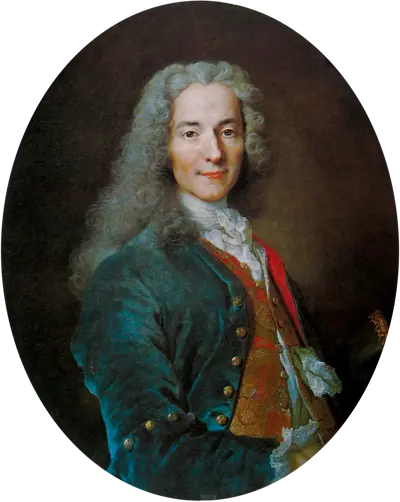
François-Marie Arouet, known by his nom de plume Voltaire (/vɒlˈtɛər, voʊl-/; also US: /vɔːl-/; French: [vɔltɛːʁ]), was a French Enlightenment writer, historian, and philosopher famous for his wit, his criticism of Christianity—especially the Roman Catholic Church—as well as his advocacy of freedom of speech, freedom of religion, and separation of church and state.
