Nelson Mandela Quotes
What right has the West, what right have the whites anywhere, to teach us about democracy when they executed those who asked for democracy during the time of the colonial era?
Why Western nations have no right to press African countries to accept democratic reforms:
Nelson Mandela, 1918-2013, President, South Africa, Deputy President, African National Congress, South Africa, Nairobi, Kenya, July 13, 1990
Sourced by: Eigen's Political and Historical Quotations


White Africaners were slaughtering Blacks to appropriate their land in violation of English law. See {583901} for a related quotation.


The issue of slavery which had been suppressed in Congress for the first decades of the nation broke out when Missouri statehood was considered. By previous agreement, slavery was not even discussed in Congress but the time period elapsed. Tallmadge not only proposed that no more slaves could come into Missouri {613176} but most shocking to the Southerners was that every person born in the new state would be free at the age of 25. In a generation, there would be no more slavery in Missouri and there would be no economic compensation for slave owners at all. The House of Representatives accepted the amendment, but it failed in the Senate. At that time, Senators were not elected by voters but were appointed by the state legislators and the Southern slave states had a disproportionate share of the senate from a population point of view. But what this quotation shows clearly that a majority of the country in 1819 were opposed to slavery and were willing to end it without compensation.

What is fascinating about this quotation is that although the head of a religion, Smith was not advocating the kinds of personal lifestyles of his church the way modern religious leaders do, but was concerned with the much larger issues of expansionism, corruption of the courts and judiciary, and land distribution. He was a classic reform candidate in that sense. Smith had written to most of the then likely Presidential candidates of both major parties asking for their position on the Mormons who were facing persecution wherever they went. None of the politicians would make any satisfactory commitments. Smith took Direct Action and became the only major religious official to have run for the Presidency of the United States until Pat Robertson tried and failed in 2000. Smith’s assassination shortly thereafter cut his run for the Presidency short before it made much headway and politically he had no chance to affect the race.


At the time Salisbury was conflating race and development so this seemed like a valid observation. However, as other nations developed, some have developed thriving democracies who are not primarily White Teutonics. India is the largest democracy in the world. Turkey is of mixed racial heritage. Singapore is Chinese and Malay. Japan has few whites. And South Korea is another Asian example.
Louis Napoleon Bonaparte. The “colonies” to which we was referring were the French Colonies in the Caribbean—particularly Haiti. The Black slaves had revolted against the slave-owners and had taken over all positions of authority and wore the uniforms and symbols of power including the epaulettes—the gold braid shoulder pieces that were symbols of high rank in military and diplomatic uniforms which were worn on all official occasions. Napoleon never did make good on his vow. He had many more problems with his own wars and governance in Europe. This quote does demonstrate the racism that existed in supposedly tolerant France.


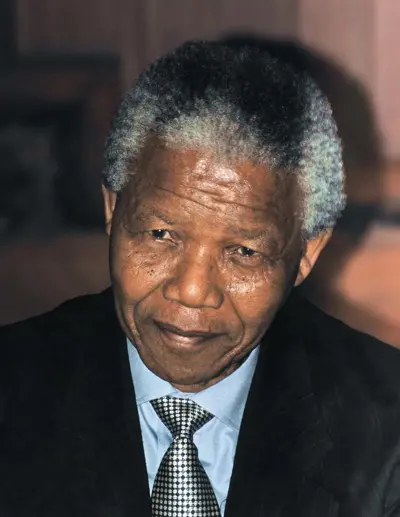
Nelson Rolihlahla Mandela was a South African anti-apartheid revolutionary, political leader and philanthropist who served as President of South Africa from 1994 to 1999. He was the country's first black head of state and the first elected in a fully representative democratic election. His government focused on dismantling the legacy of apartheid by tackling institutionalised racism and fostering racial reconciliation. Ideologically an African nationalist and socialist, he served as the president of the African National Congress (ANC) party from 1991 to 1997.
