Ali Khamenei Quotes
What makes Bush different from Hitler? He commits crimes in Guantanamo and Abu Ghraib prisons. With all these crimes, they still behave like bullying claimants. They get angry once they see an independent nation
Khanenei failed to make three important distinctions. First, the crimes committed by American forces in Abu Ghraib and Guantanamo were NOT the policy of the American government whereas all of Hitler’s crimes were not only government policy but Hitler had laws passed to enable these atrocities. Bush and the American Military command may have not been competent enough to prevent the problems, and may have been too lenient to punish the guilty, but they never intended them to occur. Second is scale. Abu Ghraib and Guantanamo illegalities led at most to the deaths of one or two people. Hitler killed over 6 million in his prisons. Third, as soon as Bush found out about the problems, they were stopped whereas Hitler continued until militarily removed from power and neutralized.
Ali Khamenei, Grand Ayatollah & Iranian Supreme Leader, May 16, 2007
Sourced by: Eigen's Political and Historical Quotations


Abu Ghraib was the prison in Iraq where prisoners were brutalized and treated illegally and immorally. Seymour Hirsh was the Pulitzer Prize-winning investigative journalist who broke the story. Levy contrasted that where the Algerian War was full of such atrocities but French intellectuals and press would not publicize it. It didn’t stop for the whole war.

Abu Ghraib was the major prison in Iraq during the Iraq War. American military committed many crimes on prisoners ranging from murder to sexual humiliation. The actual perpetrators claimed that the higher ranks of officers knew what was ongoing and provided the policies, rules and culture of the prison. The president and the Vice President many thought were the officers responsible and violated the Uniform Code of Military Justice. Their administration had issued a legal memorandum that for the first time in American history would allow some kinds of torture of prisoners in the War on Terror. A few enlisted personnel were punished and a general was transferred but no senior military or civilian personnel were held responsible or punished.


Chavez frequently insulted officials and leaders of other countries. See linked quotes for examples.


[During the Guatemalan Civil War, the military had often tortured, murdered disappeared and sexually enslaved female relatives of men they suspected of being rebel. The object was to humiliate and emasculate the insurrectionists so that others will not join them and they will cease their revolutionary activities to protect their women. The civil war ended in 1996, and although military war criminals had been tried earlier but never for crimes – sexual crimes against women. 20 year had elapsed since the end of the war and this famous trial. The two war criminals were sentenced to 120 and 240 years in prison respectively, but they had escaped justice for more than two decades. The United States, in the middle of the Red Scare was supporting and financing the Guatemalan government and military. In addition America trained many of the military in counter-insurgency which taught some methods that were contrary to International Law and which were illegal for American soldiers to engage in. After official documents of the era were declassified, it became clear that U. S. officials—–especially the CIA--were aware of the excesses and war crimes of the Guatemalan military, but did little to stop it. See Quotes 583699, and 583697 for more on the American involvement.]

Describing Egyptian President Gamal Abdel Nasser, 1918-1970


In 1936, Fascist Italy invaded Ethiopia in an effort to obtain an African colony like other European Countries had. Over 50 nations had promised aid to Ethiopia if attacked but then the Italian attacks came, it was not just soldiers with some small artillery and vehicles. Instead it was a full modern army with not only heavy artillery and tanks, but extensive use of air power against villages and towns which generally hardly had rifles. The airplane carnage of civilian populations was a shock to the world. However, the tactics were studied by the Italian German Fascist allies who further developed air power use against unarmed towns and cities in the Spanish Civil war. The aid promised to Christian Ethiopia never materialized because there was a worldwide depression and the great powers would have had to commit to major war—not just send some arms and ammunition. The Ethiopians mostly fought with spears and knives. The Fascists were thus emboldened for the invasion of Europe a few years later.


This quotation is a good example of how tolerant some nations can be in terms of maintaining diplomatic relations and trade relations with other countries. The American and English governments chose to simply protest and condemn the slanderous statement but decided that the Prime Minister was pandering to his political local Islamic base, so took no further action and kept open diplomatic relations. Mahathir had a history of being very accusatory of the West with respect to anything that affected the Arab Muslims. The number of Muslims killed by the Americans and British in the Iraq War was very small compared to the huge number of Muslims killed by other Muslims in their Sunni Shiite civil war. While Bush and Blair both generated support for the Iraq invasion by making claims of WMD development in Iraq that were false, it is not clear whether or not they knew their statements were false, should have known that they were false, created an atmosphere against Iraq that was likely to produce false accusations, or were simple misled by poor intelligence. Mahathir, of course, chose to assume the worst case, and claim it was true, which is what many people think Bush and Blair did in analyzing the intelligence on Iraq.


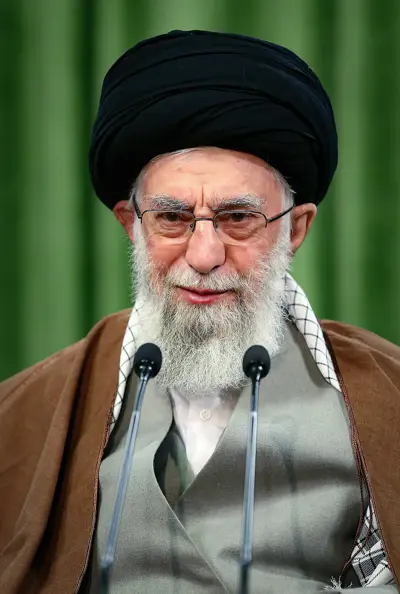
Sayyid Ali Hosseini Khamenei is a Twelver Shia Marja' and the second and current supreme leader of Iran, in office since 1989. He was previously President of Iran from 1981 to 1989. Khamenei is the longest serving head of state in the Middle East, as well as the second-longest serving Iranian leader of the last century, after Shah Mohammad Reza Pahlavi.
