Hermann Goering Quotes
What do I care about danger? I've sent soldiers and airmen to death against the enemy - why should I be afraid?
Gilbert, G. M. Nuremberg Diary. Farrar, Straus and Company, 1947, p. 278.

An example of this was the landing in the beaches of Normandy in WWII. Once on the beaches the allied troops had to win or die. Some of the most heroic fighting in American and English military history occurred on those beaches. Another was the Spanish Explorer Hernando Cortez who after landing in the New World, had his ships burned so that he and his soldiers had to conquer or they would die.


Ataturk was a young major at the time commanding troops of a weak and corrupt Ottoman regime. However a combined English and French (the strongest military powers in Europe) invasion of the Gallipoli Peninsula threatened to capture the Turkish capital, Constantinople. Ataturk alone rallied the Turkish defenders and fought the invaders to a standoff in long drawn out battle with huge casualties on both sides. Ataturk became a national hero. Although Ataturk thereafter was very reluctant to use military force or endanger troops, the thing he always thought worth the supreme sacrifice (including his own) was the independence and sovereignty of the nation. See {584502} for his continuing belief in this type of sacrifice.


Eisenhower was then the Supreme Allied Commander of the Allied Forces.


The poem was written for and inscribed upon a monument. The Atheists in Foxholes Monument was donated to Alabama Freethought Association, Inc. by the Freedom From Religion Foundation. It is located adjacent to the Willa Mae Whatley Auditorium, in Fearn Park at Lake Hypatia, Alabama.


Debs was jailed for sedition for this speech.
This was hand written the day before D-Day by Eisenhower. It was to be issued in the event of a failure of operation Overlord—the D-Day landings. The success was by no means a sure thing and the greatness of Eisenhower is indicated by the fact that he was not arrogant, kept the possibility of failure in mind, and took it upon himself to accept the responsibility of things had not gone well. This was one of the greatest quotations that was never made.

Attila the Hun. The Romans aided by Theodoric, King of the Visigoths, fought the Huns in the only battle that Attila ever lost which he lost badly. There were 165,000 men killed in an afternoon. The Roman General, Flavius Aetius, had been a boyhood friend of Attila’s and had fought with him against the Visigoths. The Romans had Attila trapped but his old friend let him escape with just a good thrashing to his ego and army as to not upset the balance of power and tilt it in favor of the Goths. Roman foreign policy at the time was to keep all the Barbarians strong enough to fight one another so that none would be dominant but all weaker than Rome. Divide and conquer.
It was then customary to return with the head of a killed Samurai which would be made up as if in life so the dead man could be recognized. That way, the victor received more recognition with the importance of the Samurai who he defeated.
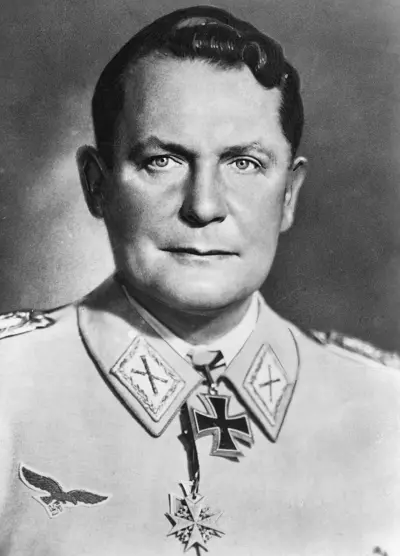
Hermann Wilhelm Göring was a German political and military leader and a convicted war criminal. He was one of the most powerful figures in the Nazi Party, which ruled Germany from 1933 to 1945.
