Robert M. T. Hunter Quotes
What did we go to war for, if not to protect our property?
McPherson, James M. Battle Cry of Freedom: The Civil War Era. Oxford University Press, 1988, p. 835.

After the attack on Fort Sumter, the South Sent “diplomats” to negotiation with the Government. Unfortunately for all, the South really was not open to negotiations as they only had two predetermined positions they would agree to: The first was that the Government should guarantee the perpetual right of states to have slavery if they wished and that fugitive slaves would be returned by the non-slave states. The second was that the Union should recognize the Confederacy as an independent nation and have peaceful relations between the two. The first was impossible to deliver even if the Union would agree to continue slavery, there was no way that the Federal Government could enforce the return of fugitive slaves from many northern states where they were free the second they set foot in the state, and the Northern states demanded States Rights and not being forced to return Fugitive Slaves forcing the Southern States to oppose States Rights when it came to Fugitive Slaves while favoring it for slavery itself. The Federal government could not enforce the Dred Scott Decision under the pro-South Buchanan administration. And Lincoln and most of the Northern Politicians would not accept a complete dissolution of the Union. There are no other possibilities the South would accept and there was really nothing to negotiate.


An earlier version was written by Congressman Louis L. Ludlow, 1873-1950—see his quotation about it—{39681}. The proposed amendment was narrowly defeated.


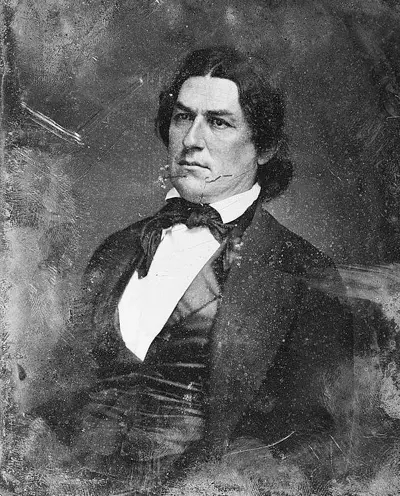
Robert Mercer Taliaferro Hunter was a Virginia lawyer, politician and plantation owner. He was a U.S. Representative (1837–1843, 1845–1847), Speaker of the House (1839–1841), and U.S. Senator (1847–1861). During the American Civil War, Hunter became the Confederate States Secretary of State (1861–1862) and then a Confederate Senator (1862–1865) and critic of President Jefferson Davis. After the war, Hunter failed to win re-election to the U.S. Senate, but did serve as the Treasurer of Virginia (1874–1880) before retiring to his farm. After fellow Democrat Grover Cleveland was elected President of the United States in 1884, Hunter became the customs collector for the port of Tappahannock until his death.
