George F. Will Quotes
What begins in Washington as simple, garden-variety grasping becomes an entitlement, the argument being that the longer the benefit has lived, the more the beneficiaries have built their lives around it, so ending it would be disruptive.
George Will, Political Columnist, Senate Staff Assistant “How Sweet It Isn’t”, The Washington Post, June 9, 2013
Sourced by: Eigen's Political and Historical Quotations

At the time there were tax breaks for large yachts but not for small boats that a middle class person might own. It was another example of the tax laws at the time where the poor paid only Social Security taxes, and the rich lobbied for an got very large tax breaks and subsidies and hence the burden was carried by an increasingly stressed middle class .and by cuts in services to the needy. The companies that made the yachts also supported the tax breaks as did the unions and workers in the industry. . See {624984}. .


This quotation pithily summarizes a common problem in politics of describing budgets. In most years there has been a national inflation. If a new budget is, in actual dollars, the same as the previous years or a little more, but the increase is less than the inflation level, the agency will not be able to provide the same level of services as the previous year. Therefore services will be cut and those who are politically in favor of more money for the program legitimately describe this as a “budget cut”. Opponents of larger funding increases, also legitimately describe the funding as a “budget increase”. One side refers to what the money can buy and the other, to the absolute dollars spent. This is an example of the classical ambiguity of political oratory.

The bills that Congress tends to pass provide benefits for very few but spread the costs over many of not the whole population. In the majority of concentrated benefits, the beneficiaries have made large campaign donations and/or have retained powerful lobbyists. They are special interests in the truest sense of the word. See {633225} for a good example of this principle.


While this is a common complaint in the American political dialogue at the beginning of the 21st century, it is interesting that this was the conclusion of a foreign political scholar studying that period—one who was generally a great admirer of America.


Between the politicians and the financial industry lobbyists the laws are written so that there is sufficient room for enough self dealing so that members of Congress can get rich using methods that are questionable but have been legislated as legal and the Congressional rules have been written so that they are “not unethical”. Many members of Congress leave the institution much wealthier than when they entered but have received salaries that are insufficient to build that kind of wealth. Many then accept lobbying or other jobs at very high pay representing the people and corporations who have been the subjects of their legislative efforts. Other members do not avail themselves of the “legal” self dealing as the practice is not universal.


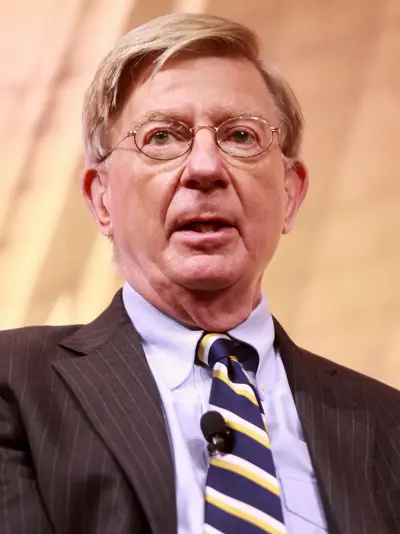
George Frederick Will is an American libertarian-conservative political commentator and author. He writes regular columns for The Washington Post and provides commentary for NBC News and MSNBC. In 1986, The Wall Street Journal called him "perhaps the most powerful journalist in America," in a league with Walter Lippmann (1889–1974). He won the Pulitzer Prize for Commentary in 1977.
