Milton Friedman Quotes
Well first of all, tell me, is there some society you know of that doesn't run on greed? You think Russia doesn't run on greed? You think China doesn't run on greed? What is greed? Of course, none of us are greedy, it’s only the other fellow who’s greedy. The world runs on individuals pursuing their separate interests. The great achievements of civilization have not come from government bureaus. Einstein didn’t construct his theory under order from a bureaucrat. Henry Ford didn’t revolutionize the automobile industry that way. The only cases in which the masses have escaped from the kind of grinding poverty you’re talking about, the only cases in recorded history, are where they have had capitalism and largely free trade. If you want to know where the masses are worse off, worst off, it’s exactly in the kinds of societies that depart from that. So that the record of history is absolutely crystal clear, that there is no alternative way so far discovered of improving the lot of the ordinary people that can hold a candle to the productive activities that are unleashed by the free-enterprise system.


While generally true, Mises here again exaggerates his “proof” by selectively ignoring or being ignorant of counter-examples. The Roman Catholic Church is a classic counter-example where priests, monks, and others owned nothing as individuals, but produced some great science (eg Gregor Mendel), art (the illuminated texts of the middle ages), literature (St Thomas Aquinas, etc). The best counter example that was just evident in the last decade of Misis’ life is Communist Russia. Russian science was better than Fance and Germany and second only to the United States. The Russian ballet and orchestras were second to none. Great literature came out of the Soviet Union and the best of it complained about and attacked the Soviet system of the times. In general, Mises principle tended to be correct throughout history but not always as he dogmatically stated.


Like many ideological political philosophers who developed a following, she tended to exaggerate many of her points and to ignore additional factors. While individual businessmen and politicians pursuing their self interests were certainly necessary for America’s great growth and success, they were not sufficient. Many of the founding fathers sacrificed their fortunes and in some cases their lives to gain American independence. And the sacrifice of millions was necessary in many conflicts were those who fought were rarely enlarging their own fortunes. And equally important factors of American success were the collective action of communities creating schools, roads, bridges, canals. The driver of the businessmen to move into critical areas was the government subsidizing the railroads, proving the telegraph useful, developing the national highway system and the Internet. Most of the great universities and research centers were created as government, charitable or religious institutions where personal profit was not a factor. It is that combination of private and public, self serving and communitarian drives, secular and religious that have created modern America. Many people in Rand’s ere did not credit the private, self serving contributions of many great men, and Rand led the movement to remind all of that critical factor. In the process of making her good point, she tended to ignore the other factors.

The implication of the investment in infrastructure and education is that the state must tax people at a rate that would pay for it. But if the rate is too high, he argues, people will not make a sufficient profit from their work.


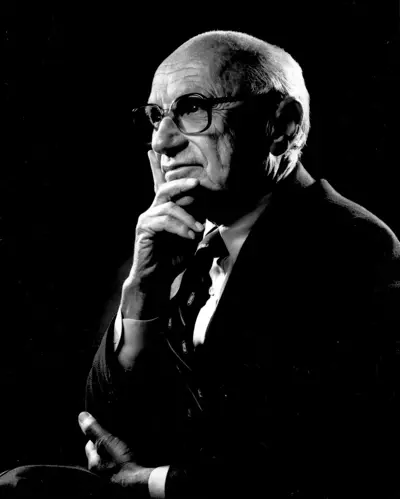
Milton Friedman was an American economist and statistician who received the 1976 Nobel Memorial Prize in Economic Sciences for his research on consumption analysis, monetary history and theory and the complexity of stabilization policy. With George Stigler and others, Friedman was among the intellectual leaders of the Chicago school of economics, a neoclassical school of economic thought associated with the work of the faculty at the University of Chicago that rejected Keynesianism in favor of monetarism until the mid-1970s, when it turned to new classical macroeconomics heavily based on the concept of rational expectations. Several students and young professors who were recruited or mentored by Friedman at Chicago went on to become leading economists, including Gary Becker, Robert Fogel, Thomas Sowell and Robert Lucas Jr.
