Edmund Burke Quotes
We should exclude murderous atheists, who would pull down Church and state; religion and God; morality and happiness .... When they smile, I see blood trickling down their faces; I see their insidious purposes; I see that the object of all their cajoling is—blood! I now warn my countrymen to beware of these execrable philosophers, whose only object it is to destroy every thing that is good here, and to establish immorality and murder by precept and example.
Debating the Aliens Bill that would reduce the influx of immigrants and refugees from France as a result of the excesses of the French Revolution and remove the civil rights that foreigners had previously had.
Edmund Burke, Parliamentary Debate on the Aliens Bill, December 28, 1792
Sourced by: Eigen's Political and Historical Quotations


See {583817} for how France was more assertive in handling this problem.

The phrase ‘This would be the best of all possible worlds, if there were no religion at all!!!’ is often quoted to imply that Adams was opposed to religion. This is a classic use of using quotations out of context for if one reads the entire quotation, Adams is stating that without religion the world would not be a particularly fit place. Some religionists then use the entire quotation to argue that Adams was a religious, Christian man who saw America as a Christian nation. That too is out of the context of the totality of his views—see {592753}.

3rd Earl Russell of Kingston. He wrote this just after turning 16.


during and after the American Revolution


This quotation so impressed Thomas Jefferson that he wrote it in his Commonplace Book.


Anne was a Protestant but her father James II was a Roman Catholic. There was always suspicion about her true religious allegiance by the extremists in the Church of England. The Act of Toleration, despite its name, required the Church of England to be the established church and the sovereign’s to be the heads of the church.


For many religions and ethical systems, it is better to have personal contact with the recipient of charity than to give money.


England had, under Henry VIII, left the Roman Catholic Church where the King replaced the Pope as head of the English Church. Henry’s successors then had to organize and manage the national Christian church. James was discussing the hierarchy of the Church of England and there was a suggestion that Bishops be eliminated and have every priest directly responsible to the crown. Bishops would be powerful figures who might form a power center. (They did later). However, King James I observed that the King is God’s choice and rules by divine right. So there had to be bishops to crown kings. The bishoprics were retained.
The Irish monks were loyal to the pope and were outraged when he was displaced by King Henry VIII. They were seen as a hotbed of disloyalty and therefore ordered to close. This is one of the many examples where an established government church dictated not only how people should worship but also prohibit other religions from functioning. These examples were well known to the American Founding Fathers and much of educated American opinion which was one of the drivers of the First Amendment and the separation of church and state.
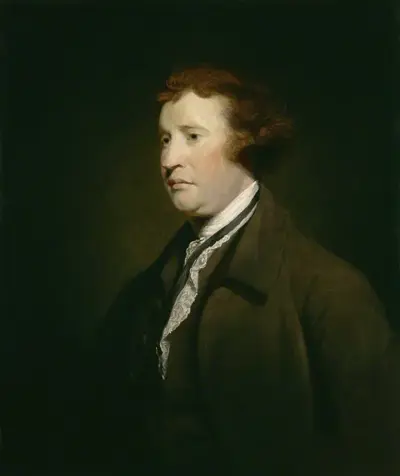
Edmund Burke was an Irish statesman, economist, and philosopher. Born in Dublin, Burke served as a member of parliament (MP) between 1766 and 1794 in the House of Commons of Great Britain with the Whig Party after moving to London in 1750.
