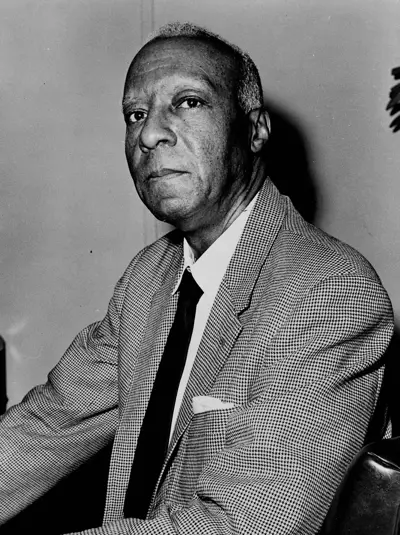
A. Philip Randolph Quotes
We seek the right to play our part in advancing the cause of national defense and national unity. But certainly, there can be no true national unity where one-tenth of the population is denied their basic rights as American citizens.
Randolph, A. Philip. "Call to Negro America to March on Washington." The Black Worker, May 1941.


The case was Shelley v. Kraemer where the Supreme Court outlawed discriminatory restrictive covenants A restrictive covenant was a condition that was written into the deed on a piece of property. Even if the owner of the home did not want to discriminate, the previous owners who wrote the restrictive covenant into the deed (or his relatives and heirs) could sue and invalidate the sale. In many cases, insurance would not sell title insurance or banks would not give mortgages for a Black or a Jew where there was a covenant in the deed, even if the covenant was more than 100 years old. Homeowner associations would also enforce the covenants which were originally written into all the deeds of the development. Once the supreme court ruled that restrictive covenants were unconstitutional, no court would enforce any of these lawsuits. It was one of the fastest steps forward in the history of Civil Rights since the day after the court decision racists could no longer enforce the covenants that were in tens of millions of deeds in America.


This was the first major civil rights speech. He had previously in his political career tread carefully in the civil rights arena. The Southerners had disproportionate control over the Congressional committee chairmanships and they could hold up his entire legislative agenda. JFK’s father was a right wing fascist who supported Hitler earlier and always advised against pushing civil rights.


In the 1930s African Americans who traveled were subject to countless humiliations whenever the sought hotels, rooming houses, restaurants and other accommodations. Gas stations would not allow them to use bathrooms and they were reduced to using open fields. Traveling and vacationing was, for Blacks, humiliating. Wikipedia: “Green reviewed hotels and restaurants that did business with African Americans during the time of Jim Crow laws and racial segregation in the United States. He printed 15,000 copies each year. In the 1930s, Green began his work by compiling data on stores in the New York area that accepted black travelers, and published his first guide in 1936. Similar guides had been published for Jewish travelers, who sometimes faced discrimination. Green's guide was so popular that he immediately began to expand its coverage the next year to other US destinations, adding hotel and restaurants as well.”