Walter Cronkite Quotes
We have overcome some terrible blows to our democracy, to the future of our democracy, to the future of our nation. We survived the Civil War and the strife that tore this nation apart.
Brinkley, Douglas. Cronkite. Harper, 2012.


President Andrew Johnson had been impeached by the House of Representatives and was being tried in by the Senate. A majority of the Senators voted for conviction but the vote was 1 short of the two-thirds that were needed. Johnson remained in office.


His prediction would come true 72 years later. He was a slave trader and a strong supporter of the institution. See {624060}. However unlike most slave supporting Southerners, he came from one of the richest families of New England. His own brother Moses Brown was an ardent abolitionist and John was able to see the arguments and forces lined up against slavery. He saw that abolitionists as the trouble makers because they were trying to change the status quo. Having much experience with Southerners and selling them many slaves, he realized early how the South was totally dependent on slavery for its economic and social way of life. Few Americans had that broad a perspective.


Lincoln had promised amnesty to Southerners who would pledge loyalty to the Union. What many feared was that this would include slave owners re-enslaving their former "property," or that the government would allow them to do so in order to stop the rebellion.


Much of the South was so insular that people knew nothing about the notion of abolition and just assumed that no one would ever consider freeing the slaves. Many never knew that it was the South that first fired on the Union troops and flag. If the North won the war, the assumption was that Northerners would then own the plantations and the valuable slaves. In reality, while all slaves were emancipated in the South, very few plantations and farms were confiscated from their Southern owners by Northerners despite the fact that there was political pressure in the North to confiscate the land of all rebels who had committed treason and use the value to repay the Union bonds and care for the wounded Union veterans and the widows of dead Union Soldiers. Eggleston was an accomplished writer who had served in the Confederate army of the Civil War. 20 year after the war he wrote a series of articles for the prestigious Northern Atlantic Monthly trying to convey the war from the Southerner’s point of view.
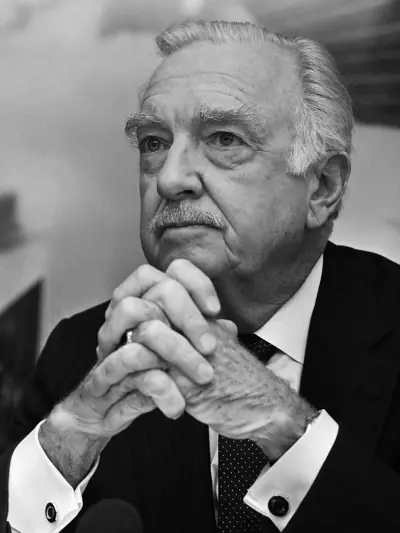
Walter Leland Cronkite Jr. was an American broadcast journalist who served as anchorman for the CBS Evening News for 19 years (1962–1981). During the 1960s and 1970s, he was often cited as "the most trusted man in America" after being so named in an opinion poll. Cronkite reported many events from 1937 to 1981, including bombings in World War II; the Nuremberg trials; combat in the Vietnam War; the Dawson's Field hijackings; Watergate; the Iran Hostage Crisis; and the assassinations of President John F. Kennedy, civil rights pioneer Martin Luther King Jr., and Beatles musician John Lennon. He was also known for his extensive coverage of the U.S. space program, from Project Mercury to the Moon landings to the Space Shuttle. He was the only non-NASA recipient of an Ambassador of Exploration award. Cronkite is known for his departing catchphrase, "And that's the way it is", followed by the date of the broadcast.
