Richard T. Ely Quotes
We have among us a class of mammon worshippers, whose one test of conservatism, or radicalism, is the attitude one takes with respect to accumulated wealth. Whatever tends to preserve the wealth of the wealthy is called conservatism, and whatever favors anything else, no matter what, they call socialism.
Ely, Richard T. Socialism: An Examination of Its Nature, Its Strength and Its Weakness, with Suggestions for Social Reform. Thomas Y. Crowell & Co., 1894.


We are still grappling with the distribution of wealth issue.


The “rebate agony” referred to a corrupt practice of the Railroads and the Large Monopolies. The railroads charged a very high rate for the transportation of important products like beef and oil. However, secretly they gave back a large percentage of the transportation rate charged to the trusts. They in turn could cut their prices and undersell all the smaller competitors who were paying “full freight” and could not afford to match the lower price. As soon as the smaller competitors were driven out of business in an area, the trust raised its rates even higher than they charged originally. The Railroad had made a small but reasonable profit on the freight of the trusts but they were guaranteed all their business. They also made huge profits on the higher rates that the small companies paid until those companies were driven out of business. Journalists like Ray Baker and Ida Tarbell had uncovered the rebate scheme which enabled the trusts to steal high amounts from the general public through unreasonably high prices. President Theodore Roosevelt was committed to try and regulate the railroads and not allow rebates but charge the same public rate to all with no rebates. Socialists like Sinclair, thought that this attempt would be hopeless—that the damage had already been done, and the trusts now had so much money that they could buy state legislatures and many in Congress to preserve their dominance.


Abrams originated this famous phrase which many have been used subsequently for various “socialized” government benefits that were available to the rich but not the poor. He was referring to the fact that at the time, the government provided housing assistance to the rich by having federally insured mortgages and granting tax deductions for the interest in home mortgages, but there was no assistance to the poor who could only afford to rent and had no tax deductions nor was there any federal public housing assistance. During the Great Recession the phrase was often used when the government gave bail out money to General Motors and the largest banks who were close to bankruptcy, but the landscaping gardener or the hot dog vendor whose business was falling because of the recession were told that is the capitalist system—there are some winners and some losers. The government officials who advocated the bailout did not disagree about the fairness and appropriateness of the Abrams phrase but if they had not bailed the banks out, the entire economic system of the country would probably have collapsed and the ensuing depression would hurt the average worker and the poor even more. Related to the recent “too big to fail” concept.


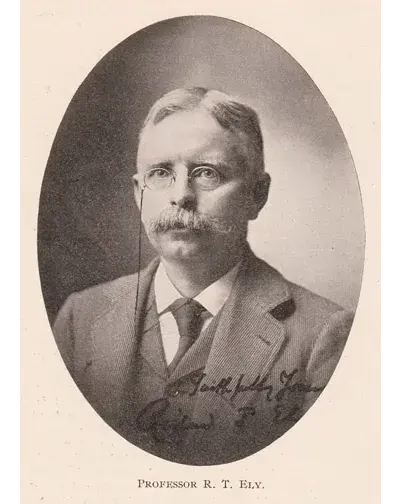
Richard Theodore Ely was an American economist, author, and leader of the Progressive movement who called for more government intervention in order to reform what they perceived as the injustices of capitalism, especially regarding factory conditions, compulsory education, child labor, and labor unions.
