Milton Friedman Quotes
We could have free immigration if we did not have a welfare state. In principle I would like to see free immigration.
Milton Friedman, 1912-2006, 1912-2006, Nobel Laureate in Economics, Quoted on PBS The Charlie Rose Show, December 26, 2005
Sourced by: Eigen's Political and Historical Quotations


When he became a national candidate, he flip flopped and modified this position to accommodate the strong anti-immigration preference of most of the Republican right wing base.


between Mexico and the United States The first non-PRI President in over 70 years.


The United States policies at the time encouraged tens of thousands of foreigners to study in America—especially mathematics, science and engineering. Then after they graduate we expel them despite the fact that we have a great labor shortage of these technical skill areas. The result is that the American economy lags in one of its most important areas, high technology for lack of qualified people to fill the jobs. Larger American companies then set up operations overseas and hire many of the people who we kicked out, so they do not pay any taxes to America. The best and most ambitious of these American trained foreigners, then start their own businesses abroad, create many jobs that never benefit Americans and then sell to America competing with American firms. New York City alone had tens of thousands of open jobs at very high salaries for which there were no Americans to fill while the New York schools had trained enough foreigners to fill the jobs, but our national policies forced the best and the brightest to leave and compete with us.
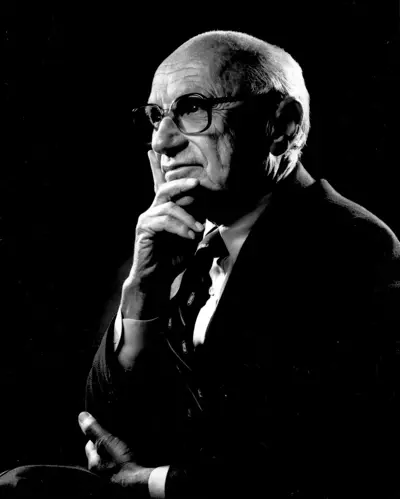
Milton Friedman was an American economist and statistician who received the 1976 Nobel Memorial Prize in Economic Sciences for his research on consumption analysis, monetary history and theory and the complexity of stabilization policy. With George Stigler and others, Friedman was among the intellectual leaders of the Chicago school of economics, a neoclassical school of economic thought associated with the work of the faculty at the University of Chicago that rejected Keynesianism in favor of monetarism until the mid-1970s, when it turned to new classical macroeconomics heavily based on the concept of rational expectations. Several students and young professors who were recruited or mentored by Friedman at Chicago went on to become leading economists, including Gary Becker, Robert Fogel, Thomas Sowell and Robert Lucas Jr.
