Bernard Baruch Quotes
We are living in a highly organized state of socialism. The state is all; the individual is of importance only as he contributes to the welfare of the state. His property is only his as the state does not need it. He must hold his life and his possessions at the call of the state.
Baruch, Bernard M. Testimony before the War Policies Commission, 1931, Washington, D.C.


Hoover, a brilliant administrator before his presidency, was so ideological about the role of government that when the Great Depression came, he was unwilling to use government directly to cope with the new problems. He was turned out of office in favor of FDR and the New Deal which the voters ratified 4 times. Hoover was embarrassed by the New Deal successes and lashed out with many insults. In this case, he called the New Deal “fascist”. See {589568} for another quote where he labels the New Deal communistic. Ironically, Hoover is rated by most historians as one of the least effective Presidents in American history while Roosevelt is always rated among the top 3 presidents.
This is just the opposite of the American Democracy in which the government serves the citizens rather than the Fascist opposite notion.


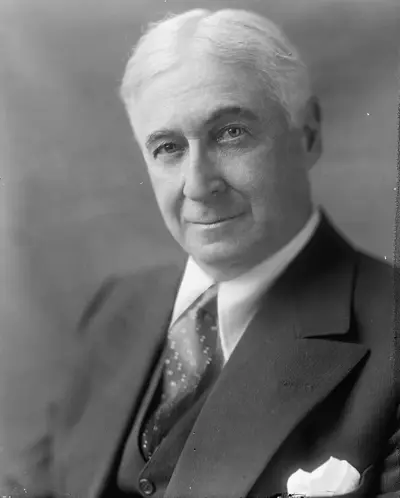
After amassing a fortune on the New York Stock Exchange, he impressed President Woodrow Wilson by managing the nation's economic mobilization in World War I as chairman of the War Industries Board. He advised Wilson during the Paris Peace Conference. He made another fortune in the postwar bull market, but foresaw the Wall Street crash and sold out well in advance. In World War II, he became a close advisor to President Roosevelt on the role of industry in war supply, and he was credited with greatly shortening the production time for tanks and aircraft. Later he helped to develop rehabilitation programs for injured servicemen. In 1946, he was the United States representative to the United Nations Atomic Energy Commission, though his Baruch Plan for international control of atomic energy was rejected by the Soviet Union.
