Jamal Bryant Quotes
We are in a state of emergency. Here in Texas, we are not afraid of ISIS. We are afraid of the police.
Jamal Bryant, Protestant Minister, Statement after another Black died mysteriously while in police custody after being arrested for a routine misdemeanor signaling violation after a white police officer forced her out of her car and treated her violently, 2015
Sourced by: Eigen's Political and Historical Quotations


Given that the Black population is less than 15 percent of the total, the odds against this occurring by chance is less than 100 million to one. The problem was then very hard to solve in that in most cases the cause was not anti-Black hostility. Rather it was that most police—including some Black police officers—were more fearful for Black males relative to white males and perceived themselves or the public in mortal danger much more often with Blacks than with whites in similar situations. Much of this was a historical societal bias and fear of Black males and much was the result of the disproportionate media depiction of violent Black males.

See {642520} for the Giuliani Statement.


She was commenting on the incident when in 2013, Congress awarded its highest honor to the 4 young Black girls who were murdered in Birmingham, Alabama at the height of the Civil Rights Movement by the KKK who set off a bomb in the 16th Street Baptist Church. The sister of Addie Mae Collins, one of the murdered girls, who herself was wounded in the bombing, refused the medal on behalf of her dead sister. She resented the fact that it had taken all these years for Congress to make this gesture and then would not do anything that might cost money such as monetary restitution. When the Muslim terrorists murdered people in the 9-11 World Trade Center attacks, Congress swiftly arranged for restitution payments to go to the relatives of the murdered victims and to those wounded. However to many people, when white terrorists murder black victims no restitution many comes forth—only a medal. See {634035} for the sister’s statement.
Instead of standing and saluting as professional athletes have done for decades before games, he kneeled and refused to stand. This caused great public criticism but also some initial support. He was potentially risking his multimillion dollar salary as this technically violated his contract to avoid anything embarrassing to the team. He also donated $1 million to programs in the area that were working to enhance Black/white understanding. Even those who disagreed with his choice of protest defended his right to do so, and after the initial furor, public opinion, while not in agreement about his method, tended to support him for having the courage of his convictions and using his celebrity for a worthy cause. After sensing the public opinion, his team matches his $1 donation. Professional athletes both in the NFL and in other sports then began to do the same as a form of protest for the large, disproportionate, number of black men who were killed, mostly when unarmed, by police. The reference to the “paid leave” was the practice followed by most police departments—usually required by collective bargaining agreements with police unions—of placing police officers accused of committing violations of laws or regulations on paid administrative leave while all the investigations, hearings, and other processes . While this practice protected the rights of those police officers who were not guilty, it ended up paying brutal murders for a some time entire their case was decided or acted upon be the district attorney.


Black protests and demonstrations were emerging throughout the country after a white police officer shot to death an unarmed black teenager in Ferguson, MO. This argument was made by a number of police apologist whites who could not understand the ferocity and passion of the demonstrations, but Giuliani was the most prominent politician taking that viewpoint. See {642521} for the refutation and response.

This is an incredibly important political and historical quotation. One of the leading white ministers of Boston, advises all Blacks (and implicitly whites as well) not to cooperate with the Boston Police. Under the Dred Scott and other legal doctrines, the law enforcement mechanism of even Northern, anti Slavery states, would arrest and hold those suspected of being runaway slaves. This included many ex slaves but also many freemen who were then enslaved by the system. Law enforcement was no better than the slave owners and the slave catchers as far as the welfare of Blacks was concerned. The result has been a hostility to and an antipathy to law enforcement in the North who – even in the view of many whites like Parker were not worthy of trust and cooperation. After slavery, law enforcement supported and enforced the Jim Crow discriminatory laws. The resentment and distrust remains.
The murderers were found and tried by Federal authorities. They were actually convicted of civil rights violations although two had committed 1st degree murder and the others of 2nd degree murder. However, the racist judge gave the murderers incredibly light sentences. See {637613}.

He was trying to calm many Americans who were upset that a young Black man who was accused of a minor misdemeanor of selling loose cigarettes (not whole packs) was being arrested by 5 white New York City police officers who thought that he was not cooperating forced him to the ground with one using a “choke hold” that was against Police Department regulations. The video, taken by a citizen, showed the arrested man crying to the police several times that he could not breathe when the pressure was placed by the officer with the choke hold. He man was choked to death. The coroner declared the death a homicide. However, the Staten Island district attorney presented the case to the Grand Jury in such a way that the jury found no reason to indict any of the police officers for any crime. Staten Island is a borough of New York far smaller and more suburban than the rest of New York System and more than half of all the white New York City police officers lived in the only conservative borough of New York where they were a major political force in the election of the borough district attorney. The President told the public that the Justice Department would investigate the case to determine if the victim’s civil rights had been violated.

Earlier, a virtually all white police force in nearby 67% Black Ferguson, had shot an unarmed black young man who was 20 feet away with his hands up, 7 times killing him and then leaving the body uncovered on the street for over 4 hours. Many people of all races began to peacefully demonstrate in Ferguson and were met with military assault weapons pointed at them and military armored vehicles, with the police illegally (as later determined by the courts) were interfering with the right to protest. The demonstrations turned to riots and there was looting and arson of business establishments. The demonstrations started to spread to nearby St. Louis and other cities as the news spread. While the Ferguson officials had behaved so badly and stupidly, the St. Louis mayor exhibited democratic leadership that was an example for others. Slay was then a 4 term mayor, being reelected more than any other mayor in St. Louis history, and was one of the outstanding politicians in America.


The law enforcement officers were the ones who broke the law when they beat and brutalized the peaceful civil rights marchers. The “white niggers” refer to the white marchers including clergy.
There is a significant argument as to whether of not race should be used to try and predict the variables that will likely produce crimes. Some social scientists argue that virtually everything correlates with race {633357} and therefore the predictions are meaningless. Here, Kurtz argues that if you do not use race, since it does correlate with so much, then you might as well not try and determine the predictive factors of crime. Reality lies in the center, use race as one of the statistical variables but do not use it for profiling potential criminals and potential suspects unless there is observable and not deduced or inferred evidence of race in the crime.
What makes this quotation so historically interesting is that the abiding by the Supreme Court’s decisions on constitutionality was even an issue. It was because of the terrible Dred Scott decision which required Northern States to return fugitive slaves to their owners despite the constitutions of those states which stated that all men were free. A substantial part of the Democratic Party was the “solid South” and the return of fugitive slaves was one of the major issues of the 1860 Presidential Election. Ironically, the Southern States were arguing AGAINST states’ rights when the Northern States’ laws and Constitutions made fugitive slaves free the minute they set foot in the state.

At the time, Wallace and many other Southern politicians were leading efforts to undermine the new Civil Rights Laws ending legal segregation. Most Southern police forces had been major vehicles for enforcing segregation and brutally suppressing any protests or demonstrations against segregation. Law enforcement officers had been active in lynchings and murders.

This painting depicted a young black girl walking to school surrounded by 4 U. S. Marshalls protecting her from the crowd of white racists trying to prevent her from attending an elementary school under court order. The vicious race hatred that school integration revealed was the national problem that was then surfacing. The graphic is the illustration that appeared in Look with that name.
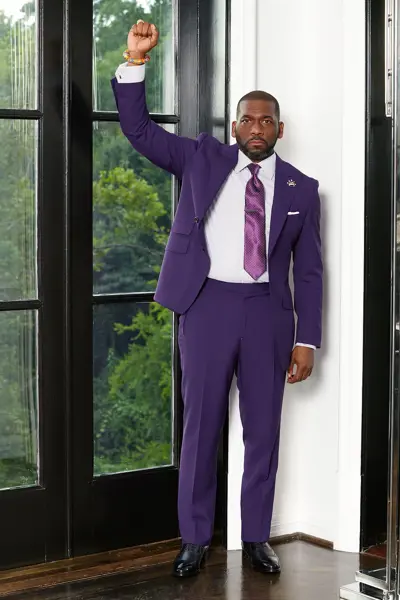
Jamal Harrison Bryant is an American minister and author. He is the senior pastor of New Birth Missionary Baptist Church. He is a graduate of Morehouse College and of Duke University. He received his doctorate of ministry degree from the Graduate Theological Foundation and his doctorate of theology from the University of Oxford in Great Britain.
