Ely S. Parker Quotes
We are all Americans, sir.
The first Native American to become a General Officer. Appointed by President Grant in 1869. When Lee arrived there were many Black troops and he mistook General Parker for a Negro but then apologized saying that “I am glad to see one real American here.” This was Parker’s reply.
Ely S. Parker, 1828-1895, Donehogawa, Seneca Iroquois Indian Chief, Engineer, and Union General, First U. S. Commissioner of Indian Affairs Statement at the Appomattox Surrender to General Robert E. Lee
Sourced by: Eigen's Political and Historical Quotations


At the time sectionalism was extensive in America. Most Iowa and Northern families still remembered a relative who had been “killed by the rebels” in the Civil War. The South still resented the rest of the country. The East and Midwest had much better educated than the rest of the country. Most important, there was very little contact between Americans of different sections. Until the great Eisenhower initiative of a National Highway System sectionalism was common. Presidents were constantly trying to develop a national American spirit.


At the time, there was very little national news in most newspapers and almost none about local areas and peoples other than the newspaper’s town. With the exception of New York and a few other cities, there was no news on the radio and TV had not yet been deployed. Most of the nation was very insular. It would not be until the Eisenhower administration that the national highway system was built. Most American spent their entire lives within 90 miles of their home and knew little about anywhere else other than NY, Chicago, Hollywood, Washington, and San Francisco.

The Southern authorities were particularly angry with people form the North coming South to demonstrate over unconstitutional and immoral segregation laws. Northerners were considered as having no business with Southern desegregation. Mrs. Peabody, and the wives of a number of wives of Christian Bishops, black and white, went to a restaurant in St. Augustine and requested service which was contrary to the segregation laws of Florida at the time. The women were arrested. The act of civil disobedience in integrating the restaurant was one act of a planned desegregation strategy worked out with Martin Luther King’s SCLC organization. The mature age of the women and their prominent husbands brought a great deal of newspaper coverage which is just what the demonstrators wanted. The photo is of Mrs. Peabody getting arrested. See {637404} and {637406} for more on this incident.


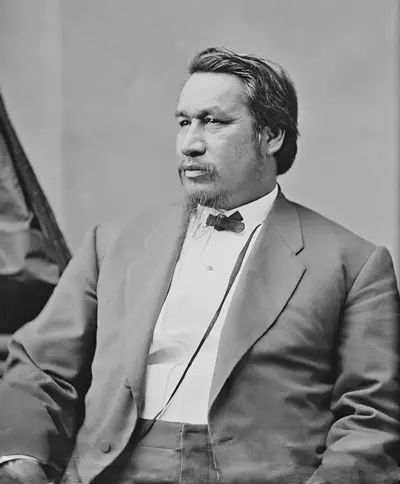
Ely Samuel Parker, born Hasanoanda, later known as Donehogawa, was a Tonawanda Seneca U.S. Army officer, attorney, engineer, and tribal diplomat. He was commissioned a lieutenant colonel during the American Civil War, when he served as adjutant and secretary to General Ulysses S. Grant. He wrote the final draft of the Confederate surrender terms at Appomattox. Later in his career, Parker rose to the rank of brevet brigadier general. When Grant was elected president, he appointed Parker as Commissioner of Indian Affairs, the first Native American to hold that post.
