Constance Baker Motley Quotes
We African Americans have now spent the major part of the 20th Century battling racism.
Motley, Constance Baker. Equal Justice Under Law: An Autobiography. Farrar, Straus and Giroux, 1998.


Jackson was a civil rights worker who was murdered by white racists trying to intimidate Blacks from their desegregation efforts. King broadened the moral responsibility to those who did not oppose the segregationist system prevalent in the South.


The president was commenting on a Donald Trump campaign statement that African American were in the worst shape in history when the reality was just the opposite

Vladimir Lenin. In their quest for world revolution, the Russian Communists had more problems with arguments in the United States whose reforms and economy had produced a very high standard of living. They knew that to effect a revolution, they had to reach the middle class and the intellectuals. They had little economically to attack America with but they were able to attack the United States morally. Even though segregation was legal in America at that time, many Americans thought it immoral. Most of the rest of the world did also. So that was one of the attack points. Since the communists opposed U. S. racial segregation, many Southern segregationists used a perverted logic and accused everyone who opposed segregation of being a communist. In addition to racial segregation, the Communists attacked other forms of discrimination such as anti-Catholic, anti-Asian, and anti-Semitic (See {638737} ) behavior.


Johnson was the first Black man who won the heavyweight championship at a time when racism in America was rampant. Many whites referred to Jeffries as “The Great White Hope” who would take the champion back for the whites. He didn’t and was beaten badly.


In that year he resigned from the War Department in protest of the discrimination and racism in the armed forces.


Johnson was then Vice President.
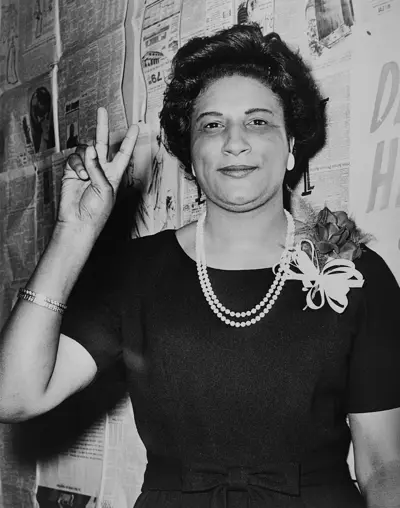
Constance Baker Motley, was a key strategist of the civil rights movement, lawyer, judge, state senator, and Borough President of Manhattan, New York City. She obtained a role with the NAACP Legal Defense and Educational Fund before entering law school as a staff attorney and continued her work with the organization for more than twenty years. She argued 12 landmark civil rights cases in front of the Supreme Court, winning nine. She was a law clerk to Thurgood Marshall, aiding him in the case Brown v. Board of Education. Baker Motley was also the first African-American woman appointed to the federal judiciary, serving as a United States District Judge of the United States District Court for the Southern District of New York. Judge Motley died on September 28, 2005 in New York City of congestive heart failure.
