Thomas Arnold Quotes
Union of action appears historically to have been the original bond of the Christian church. Whoever was willing to receive Christ as his master, to join His people, and to walk according to their rules, he was admitted to the Christian society. We know that in the earliest church there existed the strangest varieties of belief, some Christians not even believing that there would be a resurrection of the dead.
Thomas Arnold, 1795–1842, English Professor of Modern History, Oxford University, Protestant Minister & Reformer of the Anglican Church, Introductory Lectures on Modern History, Oxford University, December 1841
Sourced by: Eigen's Political and Historical Quotations


Early Christianity had a wide diversity of sect and opinion.


Quintus Septimius Florens Tertullianus. This quote is historically very important as it is one of the first expressions of religious tolerance. Tragically, this principle was ignored by most Christians for over a millennium. Some Christians still ignore it. See {626754} for a modern example.


Benjamin Franklin used almost the exact statement in a dispute of the Catholic Schools in the same year. It was unlikely that Frederick followed American politics so closely that he would have learned of Franklin’s statement, but Franklin was attuned to all the events of Europe, and this official act of the Emperor was big new for religious toleration enthusiasts. Therefore we suspect that Franklin was quoting Frederick without attribution.


Incredibly enough the same statement was issued as a Cabinet order by Frederick The Great {602503} in June 22 of the same year. It was unlikely that Frederick followed American politics so closely that he would have learned of Franklin’s statement, but Franklin was attuned to all the events of Europe, and this official act of the Emperor was big new for religious toleration enthusiasts. Therefore we suspect that Franklin was quoting Frederick without attribution.

Constantine the Great. Roman Emperors saw Christians as their most dangerous foes. However, Constantine, with this edict, enabled Christianity to thrive and grow legally in the Western world. Later Constantine himself converted to Christianity. This edict ceased the vicious Roman persecution that Christians had endured.

This was Jefferson’s definition of Christianity. However, for orthodox Christians, this was insufficient as Jefferson did not believe in the Trinity or in the divinity of Jesus. Nor did he believe in the Biblical narrative of most historical events. He was a Christian in the sense that he thought the ethics and philosophy of Jesus was as good as he had seen. See {629222}. In this sense, a number of the Founding Fathers were “Deists” including Jefferson’s conservative rival, John Adams.


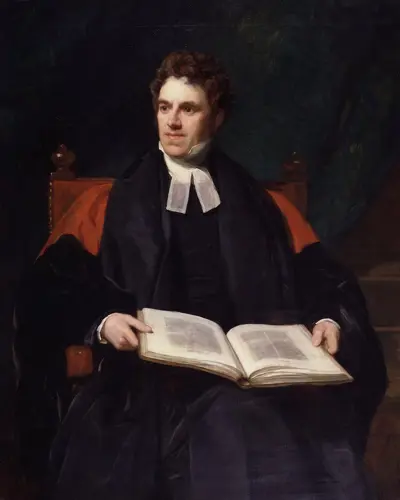
Thomas Arnold was an English educator and historian. Arnold was an early supporter of the Broad Church Anglican movement. He was the headmaster of Rugby School from 1828 to 1841, where he introduced a number of reforms that were widely copied by other prestigious public schools. His reforms redefined standards of masculinity and achievement.
