Gilbert K. Chesterton Quotes
To do Mohammed justice, his main attack was against the idolatries of Asia. Only he thought, just as the Arians did and just as the Unitarians do, that he could attack them better with a greater approximation to plain theism. What distinguishes his heresy from anything like an Arian or Albigensian heresy is that, as it sprang up on the borders of Christendom, it could spread outwards to a barbaric world.
Chesterton, G. K. The Everlasting Man. Hodder & Stoughton, 1925, p. 131.


It is often said that Judaism, Christianity and Islam share the origin in Abraham. However, orthodox Muslims use this passage of the Koran to arguer that Abraham had nothing to do with Judaism or Christianity. The time line of Abraham—according to biblical time c. 4000 BC argues more for his Judaic origins, but Western religion has his sons splitting into the great faiths. Muhammed uttered these lines roughly 600 years after the birth of Christ.
This statement by The Prophet has been interpreted by Muhammad Abduh and other Islamic modernists and reformers as a call for co-existence and common ground between Muslims on the one hand and Christians and Jews on the other. However, some Muslim extremists interpret this sura to mean that the call is for the Christians and Jews to accept Islam and THEN there will be common words. There is in modern times, there is no Islamic Hierarchy like a Pope to make a definitive determination about such an interpretation so Muslims are split on the interpretation. In that sense Muslims today are like Protestants, Jews and Buddhists.
Also inscribed in gold around the Dome of the Rock. This was the most overt statement against Christianity and the Trinity in the Koran.


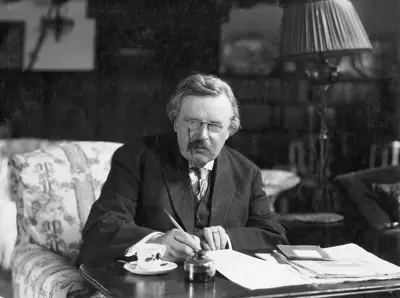
Gilbert Keith Chesterton KC*SG was an English writer, philosopher, lay theologian, and literary and art critic. He has been referred to as the "prince of paradox". Time magazine observed of his writing style: "Whenever possible Chesterton made his points with popular sayings, proverbs, allegories—first carefully turning them inside out."
