Saint Augustine Quotes
Thus there can be no doubt that the world was not created in time but with time. An event in time happens after one time and before another, after the past and before the future. But at the time of creation there could have been no past, because there was nothing created to provide the change and movement which is the condition of time.
This is a fascinating quotation. During Augustine’s time and for hundreds of years thereafter, this was accepted as obvious truth and taught by the church. When rationality permeated the Enlightenment and science flourished, this view was realized to be clearly faulty—that time started with the creation of the universe by whatever means. However, in the 21st century, new understandings of the Big Bang together with the Einstein revelation of space-time as an entity, caused many scientists to think that it just might be possible that time began with the Big Bang, and Augustine might have been right after all, though for a different set of reasons. This is another example of a difference between the scientist and the political, philosophical or religious ideologue. To the later, truth is eternal. To the scientist all truth is ephemeral and changes as our perceptions, tools, calculations, and understandings improve.
Saint Augustine, 354-430, Bishop of Hippo, Christian Church Father & Philosopher, De Civitate Dei (The City of God)
Sourced by: Eigen's Political and Historical Quotations


His concept of the devine however was quite different and much more abstract than the Rabbis, Priests and Imams of the time. Albert Einstein, was a religious Jew, but his view of God was that of Spinoza (See Quotation 631763) who had been excommunicated by the Jews. Spinoza’s ideas were considered so radical and dangerous that he was the only man in history who was excommunicated by the Catholics, the Jews and the Muslims. Spinoza did not believe in a kins of anthropromorphic God who fabricated the earth and the stars. He saw God in the devine nature of the earth and the heavens and the mathematical rules that govern everything. It was this abstraction that was Spinoza's God which made sense to Einstein. Got was in the order, physical laws and mathematics of the universe. Modern scientists who are religious have no difficulty with the probablsitic nature of much of the physics that governs the univrese. It was God who created or more abstractly, was the mathematical and physical laws that in turn allowed the universe to be created from nothing.


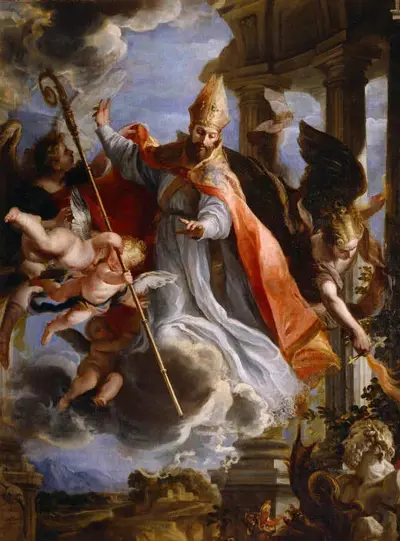
Augustine of Hippo, also known as Saint Augustine, was a theologian, philosopher, and the bishop of Hippo Regius in Numidia, Roman North Africa. His writings influenced the development of Western philosophy and Western Christianity, and he is viewed as one of the most important Church Fathers of the Latin Church in the Patristic Period. His many important works include The City of God, On Christian Doctrine, and Confessions.
