H. G. Wells Quotes
The past is the beginning of the beginning and all that is and has been is but the twilight of the dawn.
Wells, H. G. The Discovery of the Future. T. Fisher Unwin, 1902, p. 88.


This is a fascinating quotation. During Augustine’s time and for hundreds of years thereafter, this was accepted as obvious truth and taught by the church. When rationality permeated the Enlightenment and science flourished, this view was realized to be clearly faulty—that time started with the creation of the universe by whatever means. However, in the 21st century, new understandings of the Big Bang together with the Einstein revelation of space-time as an entity, caused many scientists to think that it just might be possible that time began with the Big Bang, and Augustine might have been right after all, though for a different set of reasons. This is another example of a difference between the scientist and the political, philosophical or religious ideologue. To the later, truth is eternal. To the scientist all truth is ephemeral and changes as our perceptions, tools, calculations, and understandings improve.

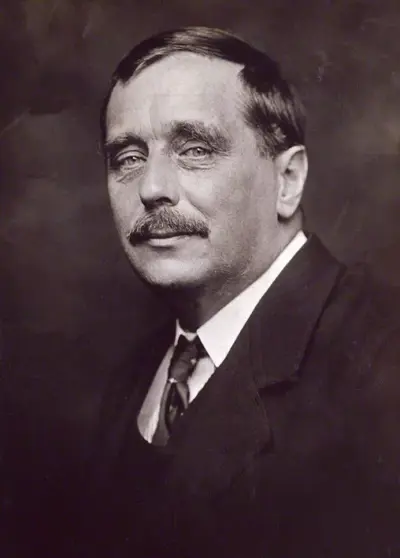
Herbert George Wells —known as H. G. Wells—was a prolific English writer in many genres, including the novel, history, politics, social commentary, and textbooks and rules for war games. Wells is now best remembered for his science fiction novels and is called a "father of science fiction", along with Jules Verne and Hugo Gernsback.[a] His most notable science fiction works include The Time Machine (1895), The Island of Doctor Moreau (1896), The Invisible Man (1897), and The War of the Worlds (1898). He was nominated for the Nobel Prize in Literature four times.
