Guglielmo Marconi Quotes
This new form of communication could have some utility.
This quotation is important for a politician or policy maker to understand. Many of the most useful technologies for mankind, were never developed for that purpose at all. In many cases, the major motivation is just understanding how a phenomenon functions, in others it just seemed like a scientific next step. In this case, Marconi was quote surprised that this new concept of radio would have much practicality.
Guglielmo Marconi, 1874–1937, Italian Inventor of Radio, Nobel Laureate in Physics, 1899
Sourced by: Eigen's Political and Historical Quotations


Not only did the Radio fail to inhibit war, but Marconi completely missed the way demagogues like Hitler and Mussolini would use propaganda via the radio to induce war in their societies. They did not justify war; they made it a national duty. Media inventors seem to have an overly optimistic view of the invention’s effect. See {635261}.


This quotation illustrates a not uncommon problem of scientists trying to explain to sophisticated businessmen or politicians new ideas in science. They have no training in trying to separate the possible from the crackpot ideas or how to take an assertion and ask for the right kinds of evidence to test it. It is probably one of the mosot difficult problems for a politician in assessing new scientific and technological ideas. In this particular case, today we all know that glass fiber can carry an immense amount of digital information, but at the time it was as foreign and idea as if someone said that we can send electricity through the air to light bulbs with no wires. Yet that is just what some scientists have shown was possible recently. Most new science appears impossible and like magic. See {368568}.


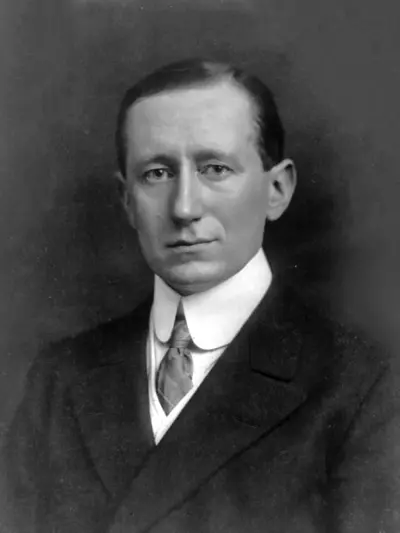
Guglielmo Giovanni Maria Marconi, 1st Marquis of Marconi FRSA was an Italian inventor and electrical engineer, known for his pioneering work on long-distance radio transmission, development of Marconi's law, and a radio telegraph system. He is credited as the inventor of radio, and he shared the 1909 Nobel Prize in Physics with Karl Ferdinand Braun "in recognition of their contributions to the development of wireless telegraphy".
