Miyamoto Musashi Quotes
This is truth: When you sacrifice your life, you must make fullest use of your weaponry. It is false not to do so, and to die with a weapon as yet undrawn.
Musashi, Miyamoto. A Book of Five Rings. Translated by Victor Harris, Overlook Press, 1974, p. 45.


It was then customary to return with the head of a killed Samurai which would be made up as if in life so the dead man could be recognized. That way, the victor received more recognition with the importance of the Samurai who he defeated.


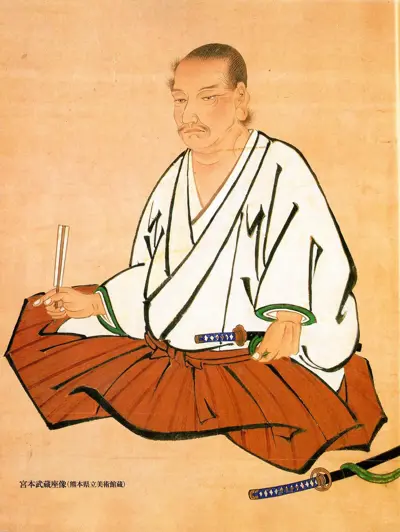
Miyamoto Musashi, also known as Shinmen Takezō, Miyamoto Bennosuke or, by his Buddhist name, Niten Dōraku, was a Japanese swordsman, philosopher, strategist, writer and rōnin. Musashi, as he was often simply known, became renowned through stories of his unique double-bladed swordsmanship and undefeated record in his 61 duels (next is 33 by Itō Ittōsai). He is considered a Kensei, a sword-saint of Japan. He was the founder of the Niten Ichi-ryū, or Nito Ichi-ryū, style of swordsmanship, and in his final years authored The Book of Five Rings (五輪の書, Go Rin No Sho) and Dokkōdō (The Path of Aloneness). Both documents were given to Terao Magonojō, the most important of Musashi's students, seven days before Musashi's death. The Book of Five Rings deals primarily with the character of his Niten Ichi-ryū school in a concrete sense, i.e., his own practical martial art and its generic significance; The Path of Aloneness, on the other hand, deals with the ideas that lie behind it, as well as his life's philosophy in a few short aphoristic sentences. The Miyamoto Musashi Budokan training centre, located in Ōhara-chō (Mimasaka), Okayama prefecture, Japan was erected to honor his name and legend.
