Herman Melville Quotes
There was about all the Romans a heroic tone peculiar to ancient life. Their virtues were great and noble, and these virtues madethem great and noble. They possessed a natural majesty that was not put on and taken off at pleasure, as was that of certain eastern monarchs when they put on or took off their garments of Tyrian dye. It is hoped that this is not wholly lost from the world, although the sense of earthly vanity inculcated by Christianity may have swallowed it up in humility.
Melville, Herman. The Piazza Tales and Other Prose Pieces, 1839-1860. Northwestern University Press and The Newberry Library, 1987, p. 408.


The Pilgrims at Plymouth celebrated the first American Thanksgiving in 1621. George Washington had declared November 26, 1789 a day of thanksgiving. During the raging Civil War, President Lincoln had fixed the last Thursday of November to be a “Day of Thanksgiving”. Geary was following precedent and helping to make a tradition. However, there were those at the time who objected to the last sentence of the quotation as being overly sectarian and violating the separation of church and state doctrine. See

While many think the significance of this quotation lies in the fact that Constantine I accepted Christianity, there is another significant aspect to it. Note the “cruel and miserable” phrase used to describe men being assigned to weave linen. This terror of doing women’s work illustrates the macho chauvinism and sexism of the time. It never occurred to Constantine I or many others, that if doing weaving was not consistent with a state of freedom, then the society had relegated the women to a degrading role where they could weave all day and thus never be free.


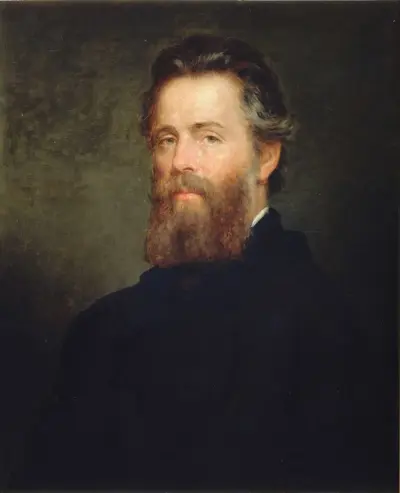
Herman Melville was an American novelist, short story writer, and poet of the American Renaissance period. Among his best-known works are Moby-Dick (1851), Typee (1846), a romanticized account of his experiences in Polynesia, and Billy Budd, Sailor, a posthumously published novella. Although his reputation was not high at the time of his death, the centennial of his birth in 1919 was the starting point of a Melville revival and Moby-Dick grew to be considered one of the great American novels.
