Milton Friedman Quotes
There is still a tendency to regard any existing government intervention as desirable, to attribute all evils to the market, and to evaluate new proposals for government control in their ideal form, as they might work if run by able, disinterested men free from the pressure of special interest groups.
Friedman, Milton. Capitalism and Freedom. University of Chicago Press, 1962, p. 197.


Professor Epstein is a libertarian free market economist who advocates patience even if there are clear problems like corruption, unsafe working conditions, and the like. This view holds that the free market will sort itself out more effectively than the government will be able to do. Others, disagree.


To the modern reader utterances such as this from a Conservative Prime Minister seem astounding. However, the Great Depression existed in Canada as well as the United States, and Franklin Delano Roosevelt was not the only world leader who would reach the conclusion that business and capitalism must be profoundly regulated and the system changed if it was to be saved.


Some economic conservatives see little or no role for government. For many of them, in a free market there is no role for government. This quotation, from one of the economic heroes of the conservatives, shows that he not only saw a role for government, but believed that government was essential to the operation of a free market.

Whenever price controls have been tried, there always seems to develop a black market. However, some argue that price controls can work very well for a modest period of time in a national emergency and give WWII as an example. Although there was a black market, very few Americans participated in it, and the effect was positive as a result of the patriotism that was so keenly felt by most Americans at that time. Further, capital punishment has rarely worked to prevent any illegal activity. In London, pickpockets were publicly hung while other pickpockets fleeced the crowd watching the hanging ostensibly to dissuade people from pickpocketing.

The prime minister had a political and philosophical position that government should not interfere with or set or control pricing in the economy. However, a scandal broke out involving payday lending—short term lending the working class does to tide them over till pay day if they run out of money. Lenders were charging huge interest rates beyond anything that is conscionable. Cameron’s government placed controls on interest rates and other facets of that industry as they might have lost a vote of confidence in Parliament had they not acted. He was then questioned about the hypocrisy involved in his regulation, and he gave this amazing quotation, which was the classic reason for government price controls on the private sector that had been given by the Labor Party opponents for years. This also distressed extreme conservatives, who argue that market controls are always preferable to government controls.
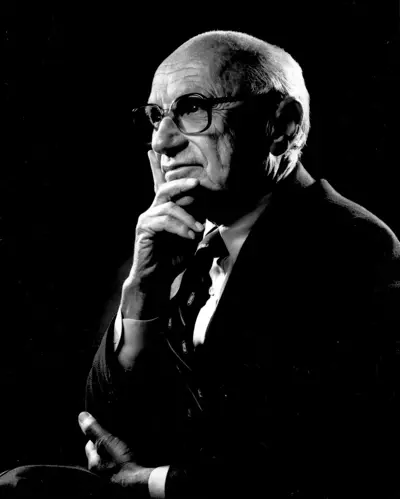
Milton Friedman was an American economist and statistician who received the 1976 Nobel Memorial Prize in Economic Sciences for his research on consumption analysis, monetary history and theory and the complexity of stabilization policy. With George Stigler and others, Friedman was among the intellectual leaders of the Chicago school of economics, a neoclassical school of economic thought associated with the work of the faculty at the University of Chicago that rejected Keynesianism in favor of monetarism until the mid-1970s, when it turned to new classical macroeconomics heavily based on the concept of rational expectations. Several students and young professors who were recruited or mentored by Friedman at Chicago went on to become leading economists, including Gary Becker, Robert Fogel, Thomas Sowell and Robert Lucas Jr.
