Milton Friedman Quotes
There is no place for government to prohibit consumers from buying products the effect of which will be to harm themselves.
His antigovernment views were so extreme that he even opposed having the government control poisonous and other dangerous consumer products and instead leave it to the free market where the consumer would have to make safety decisions often without information or worse with deceptively false information.
Milton Friedman, 1912-2006, Nobel Laureate in Economics, Free to Choose, 1980
Sourced by: Eigen's Political and Historical Quotations


In 1905 President Roosevelt supported a Pure Food act. Business interests opposed it with such arguments as:

1st Baron Macaulay. This issue is still debated in America. Until the latter part of the 20th century, businesses could sell supposed medicines without any proof of efficacy or safety. The Government or others had to prove that there was something wrong with the product. Then, that shifted, and the burden of proof fell on the developer and seller of medicines as Macaulay favored, but sellers of vitamins and dietary supplements were exempted and operated under the previous American (anti Macaulay) position. Ironically, political opponents of requiring the drug company to prove safety and efficacy claimed that this was a radical new, untested idea that would inhibit development of medicinals. They did not realize that 150 years earlier, this was a standard, accepted point of view in England. Even into the 21st century, America operated with the inconsistent difference between vitamins and supplements, many of which have no beneficial effect whatsoever, and medicines.


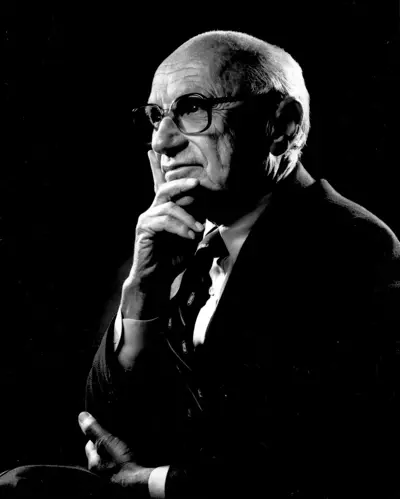
Milton Friedman was an American economist and statistician who received the 1976 Nobel Memorial Prize in Economic Sciences for his research on consumption analysis, monetary history and theory and the complexity of stabilization policy. With George Stigler and others, Friedman was among the intellectual leaders of the Chicago school of economics, a neoclassical school of economic thought associated with the work of the faculty at the University of Chicago that rejected Keynesianism in favor of monetarism until the mid-1970s, when it turned to new classical macroeconomics heavily based on the concept of rational expectations. Several students and young professors who were recruited or mentored by Friedman at Chicago went on to become leading economists, including Gary Becker, Robert Fogel, Thomas Sowell and Robert Lucas Jr.
