Charles Handy Quotes
There is as far as I know, no example in history, of any state voluntarily ceding power from the centre to its constituent parts.
Handy, Charles. The Age of Paradox. Harvard Business School Press, 1994, p. 138.

Not only did the people in Afghanistan have very little experience with central government, but they had little history of government of any sort. There were loose tribes somewhat unified by culture, but there was little or no tribal government. The same with clans. Each Afghanistan male was his own ruler over his wives and children in a family centric society. While virtually all were Muslim, there was no hierarchy or structure of the clergy in that society.


There was huge pressure on the central government to decentralize as they held all the power in Indonesian society. However, if they devolved power to the Provinces (States), many of them could be large enough and independent enough to secede and become an independent country as East Timor had done. So the Indonesian power structure bypassed the Provincial governments and devolved power directly to the local governments, none of which was independent enough to go it alone. The desired objective was met—no more secessions. However, there was no one to worry about regional and national issues and problems as the politicians who had power were all local. The country was becoming non-functional in many ways.


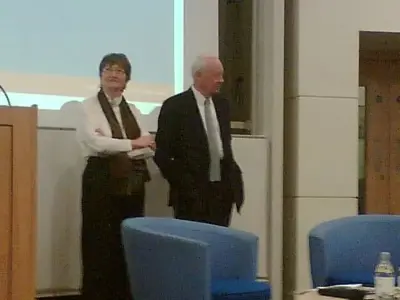
Charles Handy CBE is an Irish author/philosopher specialising in organisational behaviour and management. Among the ideas he has advanced are the "portfolio career" and the "Shamrock Organization" (in which professional core workers, freelance workers and part-time/temporary routine workers each form one leaf of the "Shamrock").
