Charlton Heston Quotes
There are no good guns. There are no bad guns. Any gun in the hands of a bad man is a bad thing. Any gun in the hands of a decent person is no threat to anybody — except bad people.
Charlton Heston, 1923-2008, Actor, President, National Rifle Association [NRA], NBC Meet the Press, May 18, 1997
Sourced by: Eigen's Political and Historical Quotations


There were very few people who believed that a pistol would have no defensive value then and there are very few today. The advocates of gun control grant its defensive value, but argue that the rise of using a gun is greater than the benefit of the use. Add to that the deaths from suicides and gun accidents which kill more Americans than those who are shot and killed intentionally.


He was unhappy about the fact that the Royal Canadian Mounted Police were still routinely carrying guns on duty. In England and Canada there has been a tradition of police officers on their beats being unarmed. When more force is needed special armed police are dispatched.


The National Rifle Association was Founded by men who were distressed that young men from the cities were so unskilled with firearms when the served in the Civil War that they thought that there should be an organization devoted to teaching the skilled use of firearms in case of another war. Frederick, the President, was himself a skilled marksman having won several of the shooting events in the Olympics. The officers and the organization in the early days and received free ammunition from the Federal Government with which to train and certify young men in shooting accuracy. The organization, alarmed at the high rage of gun accidents causing death and serious injury added gun safety to their program and this was followed by teaching and certifying Hunting Safety as well. Their vision was that marksmanship and safety through their courses and programs would be implemented by schools, camps, scouts, clubs and other intermediary organizations which were certified by the NRA.

This quotation is often provided by historians studying the gun culture of America. Even conservatives like Ames did not see a gun or an armed citizenry as important to America’s survival or well being. Contrary to popular belief, even the State Militias’ whose rights to bear arms was written into the Second Amendment did not bother to do so. In 1803 only three state militias had rifle companies. Firearms of the time were expensive, difficult to maintain, and hard to use. Unless one needed them for defense, it was too much of a bother. Even in the aftermath of the War of 1812 only 30% of Massachusetts adult men owned guns; by 1839, the rate was below 10%. It was on the frontier where guns were popular and necessary. See {613080}.


In Colombia, as in the U. S., there are many more deaths and injuries to family members caused by guns in homes, then there are deaths or injuries caused by intruders, robbers or other bad actors. However, for many Americans—especially men—they would prefer the risk of a gun in the home, than the indignity of being unable to defend their families and themselves. In essence, this is the crux of the gun control debate. Both sides are right and just reflect different values.

Like many other ideologues, the Senator was a better politician than he was a historian. He had a tendency to not be very accurate in his facts. In this particular gaff, which was castigated by critics, he was wrong about both facts he gave. First, not only was it not the case that there were few gun crimes “back then”. See {640086} and {640085} . Second his implication that everyone carried guns, and the guns were responsible for the “low” gun crime rate, was also false. Gun crime was so prevalent that most towns and cities in the West had gun control ordinances prohibiting carrying guns in the city limits. The famous Gunfight at the OK Corral which the Senator cited was in Tombstone, AZ in 1881. At that time, it was illegal to carry a gun in Tombstone. See {640063} for the gun control ordinance. As a matter of fact, the OK Corral gunfight was fought because Sheriff Wyatt Earp was disarming some cowboys who brought their guns to town. Glen Kessler, The Washington Post fact checker gave this quotation “3 Pinocchios”.

Although written by a science fiction writer, this is one of the best quotations arguing for widespread gun ownership.
Gunsmiths were few in early America and a skilled gunsmith could only make about 3 per month. As a result guns in early America were a luxury and few Americans orned them. This is contrary to the myth that the early Americans were all gun owners and sharpshooters.

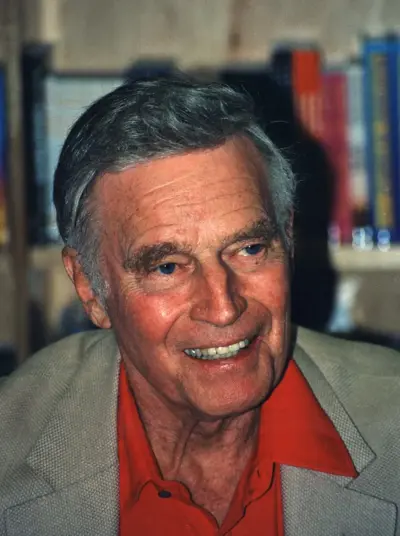
Charlton Heston was an American actor and political activist. As a Hollywood star, he appeared in almost 100 films over the course of 60 years. He played Moses in the epic film The Ten Commandments (1956), for which he received his first nomination for the Golden Globe Award for Best Actor – Motion Picture Drama. He also starred in The Greatest Show on Earth (1952), Secret of the Incas (1954), Touch of Evil (1958) with Orson Welles, The Big Country (1958), Ben-Hur (1959), for which he won the Oscar for Best Actor, El Cid (1961), The Greatest Story Ever Told (1965), Planet of the Apes (1968), The Omega Man (1971) and Soylent Green (1973).
