Albert Einstein Quotes


He served Presidents Reagan, Clinton, and both Bushes

See {523533} and {596221} for earlier similar views by Edmund Burke.

“Liberalism” was a catch all Chinese term at the time which was very derogatory in Communist vernacular very much like the negative connotation of liberalism to American Conservatives at the turn of the millennium 1990-2010.


Supporting an extension of the ban on antisatellite weapons:


He was following the lead of Colin Kaepernick—Quote 643305. Instead of standing and saluting as professional athletes have done for decades before games, Kaepernick had kneeled and refused to stand as a protest about the large number of unarmed Black young men who had been killed by police. . This caused great public criticism but also some initial support. Athletes who did this were potentially risking their multimillion dollar salary as this technically violated their contract to avoid anything embarrassing to the team. He also donated $1 million to programs in the area that were working to enhance Black/white understanding. Even those who disagreed with his choice of protest defended his right to do so, and after the initial furor, public opinion, while not in agreement about his method, tended to support him for having the courage of his convictions and using his celebrity for a worthy cause. McCourty and other players also followed Kaepernick’s lead. Soon it became a movement in professional and college athletics.


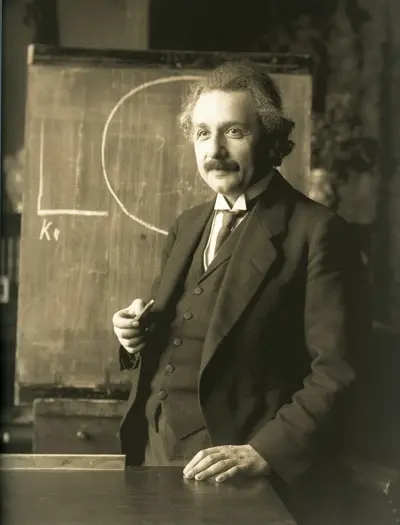
- Born: March 14, 1879
- Died: April 18, 1955
- Nationality: German, Swiss, American
- Profession: Physicist
Albert Einstein was a German-born theoretical physicist, widely acknowledged to be one of the greatest physicists of all time. Einstein is known for developing the theory of relativity, but he also made important contributions to the development of the theory of quantum mechanics. Relativity and quantum mechanics are together the two pillars of modern physics. His mass–energy equivalence formula E = mc2, which arises from relativity theory, has been dubbed "the world's most famous equation". His work is also known for its influence on the philosophy of science. He received the 1921 Nobel Prize in Physics "for his services to theoretical physics, and especially for his discovery of the law of the photoelectric effect", a pivotal step in the development of quantum theory. His intellectual achievements and originality resulted in "Einstein" becoming synonymous with "genius".
