Jamal Khashoggi Quotes
The virtual Saudi Arabia actually exists in its rules and in the minds of the people. For instance, in virtual Saudi Arabia there is no satellite television. In principle, and by law, you are not allowed to own a satellite dish. But in reality we are the biggest consumers of satellite television in the Middle East. Not only that, Saudi businessmen are also the biggest investors in satellites. In principle, and by law, Saudi Arabia is not supposed to have interest-based banking, but in fact ninety per cent of our banking system is interest-based. And it goes on and on. The solution for Saudi problems is to bring the virtual world and the real world together.
Jamal Khashoggi, Saudi Arabian Newspaper Editor, Media advisor to Saudi Ambassador Prince Turki Al-Faisal, Interview with Lawrence Wright, The Kingdom of Silence”, The New Yorker, January 5, 2004
Sourced by: Eigen's Political and Historical Quotations

This was a radical speech for the time, suggesting reforms that had been unthinkable to most Turks. Although it is not prohibited by the Koran and early Islamic artists made some of the greatest paintings and depictions of people, fundamentalists gained control of Islam and interpreted any statue as an idol that could be worshipped and this generalized to Islamic art in general where people ceased to be depicted and even animal depictions were rare. Muslim art developed incredible geometric intricacy but tended not to depict anything that is real. This extended to photography and illustrations in books including textbooks. At the same time, not unlike some Christian and Jewish Fundamentalists, the Muslim fundamentalists opposed science and the teaching thereof on the grounds that all authentic knowledge was in the Koran and anything else was not only false but also heretical. So this speech was a type of “declaration of war” against the established religious order and culture.

The pre WWII Zionists who returned to the Holy Land brought with them, the education, culture, technology, and particularly the modern scientific methods of agriculture and irrigation. The Arabs lived the same way as they had done since 1100 when the Muslim world "closed" to new ideas and change. At that earlier time, the Arabs had the advanced agricultural techniques which Europeans copied throughout Spain and Italy. While advanced for 1100, Arab agriculture was backward by early 20th century standards. Arab farms could mostly just feed the land owning family and produced little surplus, and they wasted huge amounts of water in the process. The returning Jews assumed that the Arabs would welcome these new techniques as well as the public health, medicine, engineering and science. They thought that they were bringing great gifts to the non-Jewish inhabitants of the land. However, even though the Jewish farms improved the quality of the produce and increased the productivity many times with much less water needed, for the most part, the Arabs would not depart from their traditions and religious dictates. One of the reasons Islam had been so successful in its inception was that it prescribed behavior in every phase of life, not just religious. But then it became very difficult to change. So the benefit that the Zionists thought that they were bringing back to the Middle East were not seen as benefits by the Arabs whose various cultures and countries have remained religiously and tradition bound even into the 21st century.


Eckner’s team had known that the hydrogen gas they used in all the Zeppelins of the day was very explosive. They also knew about helium which while non-flammable, was heavier and more expensive. They had developed procedures that they thought were safe for using the hydrogen, and with no problems with hydrogen they dreamed of having airships all over the world, replacing ocean liners for passenger travel. The fundamental science however was clear that any kind of spark or minor explosion could cause the entire airship to ignite. That is what happened with the Hindenburg in Lakehurst, New Jersey where 36 people died. Dr. Eckner, an anti-Nazi, wanted to partner with America to invest in the helium technology, but Hitler’s regime would not hear of it as it would make the United States the world headquarters and maintenance center for the world’s airships. That destroyed confidence in airships and the very promising technique died despite the fact that had they followed the scientists and used helium, airships would probably be in use today.


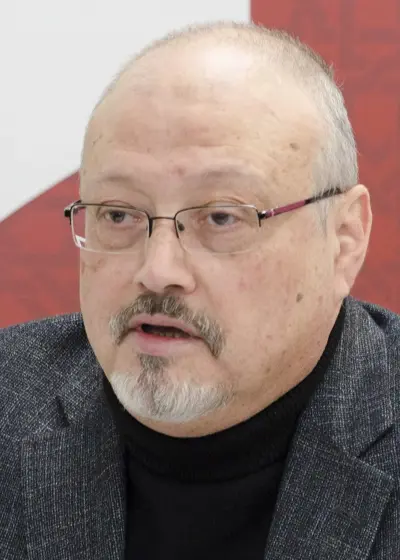
Jamal Ahmad Khashoggi was a Saudi Arabian journalist, dissident, author, columnist for The Washington Post, and a general manager and editor-in-chief of Al-Arab News Channel who was assassinated at the Saudi consulate in Istanbul on 2 October 2018 by agents of the Saudi government, allegedly at the behest of Crown Prince Mohammed bin Salman. He also served as editor for the Saudi Arabian newspaper Al Watan, turning it into a platform for Saudi progressives.
