Wilhelm II, German Emperor Quotes
The tsar [Nicholas II] is not treacherous but he is weak. Weakness is not treachery, but it fulfils all its functions.
Massie, Robert K. Nicholas and Alexandra. Atheneum, 1967, p. 81.


TR won the Nobel Peace prize for mediating between Czarist Russia and the Japanese both of which believed he thought well of them.

The French Revolution with the rise of Napoleon was a classic example. The American Revolution was an exception.

America initially withheld recognition of the 1917 Russian revolutionary government and joined a number of other nations in stationing troops around Russia. The fear of Marxism was the beginning of the Red Scare in America. Ironically, in the early years after the Russian revolution, Russia had a relatively democratic government. The dictatorship of a few at the head of the Communist Party had not yet evolved. Ironically, when we did recognize Russia again it was after it had gone through a short lived democratic period, and was in the hands of a dictatorial few. America and many other nations valued stability and predictability more so than democracy. Hearst was one of the few American notables who saw the hypocrisy of this.


The Romanovs were the family of the Russian Czars while the Hapsburgs were the family names of the Emperors of Austria. The Austrian Army Chief of Staff hated the Russians and was constantly urging war against Czarist Russia. The archduke, the heir to the Austrian throne, was constantly arguing against attacking Russia. When Franz Ferdinand was assassinated, it triggered WWI. He was no longer able to have a voice against war, and Austria and Russia were soon at war. At the end of WWI, the Austrian Empire—an ally of Germany was broken up and the Russian Revolution ended the Romanov dynasty. The Archduke was absolutely right.


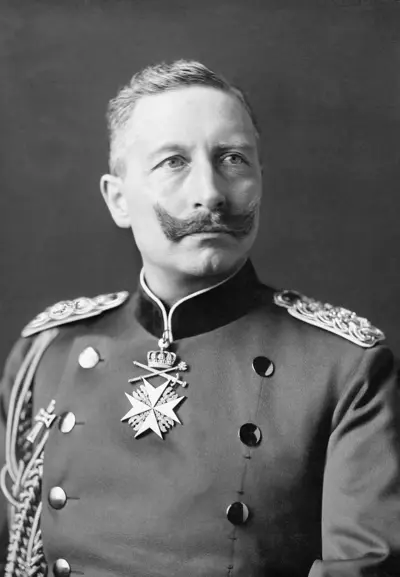
Wilhelm II, anglicised as William II, was the last German Emperor (Kaiser) and King of Prussia, reigning from 15 June 1888 until his abdication on 9 November 1918. Despite strengthening Germany's position as a great power by building a blue-water navy and promoting scientific innovation, his tactless public statements greatly antagonized the international community and his foreign policy was seen by many as one of the causes for the outbreak of World War I. When the German war effort collapsed after a series of crushing defeats on the Western Front in 1918, he was forced to abdicate, thereby bringing an end to the three-hundred-year rule of the House of Hohenzollern.
