Mary McLeod Bethune Quotes
The true worth of a race must be measured by the character of its womanhood.
Mary McLeod Bethune, 1875-1955, Educator, Speech, Chicago Women's Federation, June 3, 1933
Sourced by: Eigen's Political and Historical Quotations


She was instrumental in outlawing slavery and two years after this speech she and her daughters appeared in public without the traditional Burka or veils. The conservative fundamentalists were outraged and they deposed her husband and her modern influence ended.

This observation has never been really taken seriously until the women’s movement stimulated historical and sociological studies to test such a hypothesis. More and more people are finding that Tocqueville may have been right on this point albeit still not a majority of scholarly opinion.

Turkey, the only Islamic nation where women have equal rights, made huge developmental and reform strides immediately after Ataturk reformed Turkish society and gave women the vote, freed them from veils and chadors, educated them and gave them equal employment rights. Turkey moved from an impoverished 3rd world nation to a modern industrialized democracy.

The importance of women in the Hamas, fundamentalist vision is to function as a brood mare to “manufacture” men and then to bring them up which at least requires something more than their bodies. The role of women in producing other women however is never mentioned as important.


At the time and for the next decade she was one of the few world leaders who made women’s equality and rights a major priority. But slowly American and European women and many men began to give higher priority to using foreign policy and foreign aid. Then women from Asia and Africa began to take up the issue and in the early 21st century even some women in the Islamic nations began to fight for women’s rights. Mrs. Roosevelt. However, was the first modern major and high visibility politician to make women’s rights a major international and national issue.


Jinnah was a modern Islamist who saw the role of females in a modern context. He, like the Indian Hindu leaders were in a sense products of the West and Western government and education. He would be very surprised that in his Pakistan men can murder their female relatives who they believe have dishonored the family, or that women would not be educated in the Madrassas, or that authorities could sentence a female relative of a man deemed guilty of seduction to be gang raped, but that is what happens in modern Pakistan. Jinnah and many of the early leaders believed that their new government could modernize Islam but the control and influence went the other way. Pakistan became a religiously dominated autocracy rather than the democracy that Jinnah foresaw.


Her audiences were all familiar with the Adam & Eve Biblical narration.


He served a jail sentence in Britain for inciting race hatred.
Jinnah was a modern Islamic reformer as this quotation demonstrates. Pakistan is not as backward as most of the Arab Islamic countries on the role of women. There are many Pakistani businesswomen and professionals. Pakistan has even had a female president. However, the fundamentalist Islamic forces that dominate the culture constantly preach and advocate the literal interpretation and following of Sharia which calls for a traditional, subservient traditional role for women; “honor killings” are common; “a rapist cannot be convicted on a female victims testimony; there are calls for the killing of adulteresses and other primitive throwbacks. Jinnah’s vision has not come to pass yet.


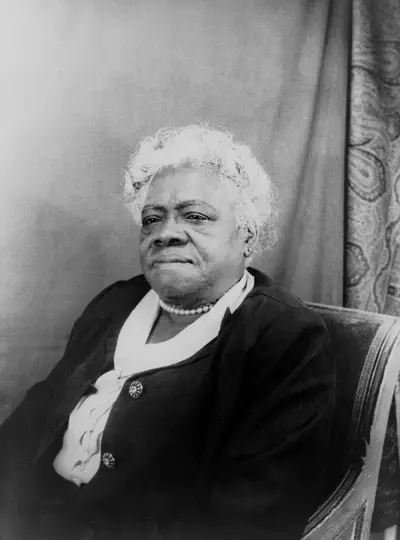
Mary Jane McLeod Bethune was an American educator, stateswoman, philanthropist, humanitarian, womanist, and civil rights activist. Bethune founded the National Council for Negro Women in 1935, established the organization's flagship journal Aframerican Women's Journal, and resided as president or leader for myriad African American women's organizations including the National Association for Colored Women and the National Youth Administration's Negro Division. She also was appointed as a national adviser to president Franklin D. Roosevelt, whom she worked with to create the Federal Council on colored Affairs, also known as the Black Cabinet. She is well known for starting a private school for African-American students in Daytona Beach, Florida; it later continued to develop as Bethune-Cookman University. Bethune was the sole African American woman officially a part of the US delegation that created the United Nations charter, and she held a leadership position for the Women's Army Auxiliary Corps. For her lifetime of activism, she was deemed "acknowledged First Lady of Negro America" by Ebony magazine in July 1949 and was known by the Black Press as the "Female Booker T. Washington". She was known as "The First Lady of The Struggle" because of her commitment to gain better lives for African Americans.
