Aristotle Quotes
The true and the approximately true are apprehended by the same faculty; it may also be noted that men have a sufficient natural instinct for what is true, and usually do arrive at the truth. Hence the man who makes a good guess at truth is likely to make a good guess at probabilities.
Aristotle. Rhetoric. Translated by W. Rhys Roberts, Clarendon Press, 1924, 1355a.


There is a great tendency in politics and government operations to get extremely precise numbers because political opponents will always attack all numbers that do not support their positions. The result is that typically, so much time and money goes into trying to get precision, that by the time the numbers are good enough the opportunity to make the right policy decision will have passed. Much information that bears on an issue is never used because it is not precise enough while the precise information is not particularly relevant. See {619763} for a similar related quote.


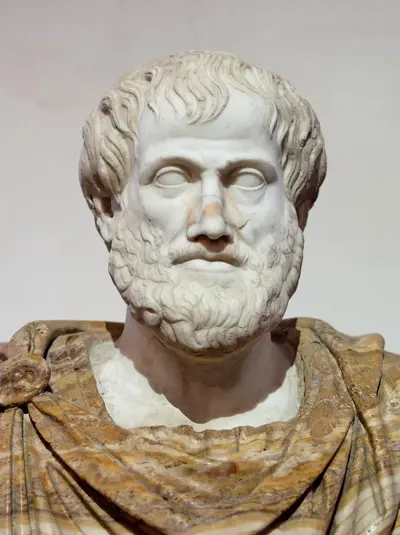
Aristotle (/ærɪˈstɒtəl/; Greek: Ἀριστοτέλης Aristotélēs, pronounced [aristotélɛːs]; 384–322 BC) was a Greek philosopher and polymath during the Classical period in Ancient Greece. Taught by Plato, he was the founder of the Lyceum, the Peripatetic school of philosophy, and the Aristotelian tradition. His writings cover many subjects including physics, biology, zoology, metaphysics, logic, ethics, aesthetics, poetry, theatre, music, rhetoric, psychology, linguistics, economics, politics, meteorology, geology and government. Aristotle provided a complex synthesis of the various philosophies existing prior to him. It was above all from his teachings that the West inherited its intellectual lexicon, as well as problems and methods of inquiry. As a result, his philosophy has exerted a unique influence on almost every form of knowledge in the West and it continues to be a subject of contemporary philosophical discussion.
