Karl Marx Quotes
[T]he task of abolishing the essence of Jewry is in truth the task of abolishing Jewry in civil society, abolishing the inhumanity of today's practice of life, the summit of which is the money system.
Marx, Karl, and Friedrich Engels. The Holy Family. Foreign Languages Publishing House, 1956, p. 147.


In his early years, Stalin was a strong opponent of Anti-Semitism ({627514}) but he felt he needed to make a pact with Nazi Germany—the Hitler-Stalin Pact. In meeting with Nazi Foreign Minister Ribbontrop, Stalin as a quid pro quo promised to get rid of “Jewish Domination” (which never existed but there were many Jews in positions) among officials and intellectuals. He then fired his Jewish Foreign Minister Litvonof and replaced him with Vyacheslav Molotov to whom he have this instruction. This was the first major official Anti-Semitism of the Soviet Union but it continued thereafter. See {636526} & {636527}.

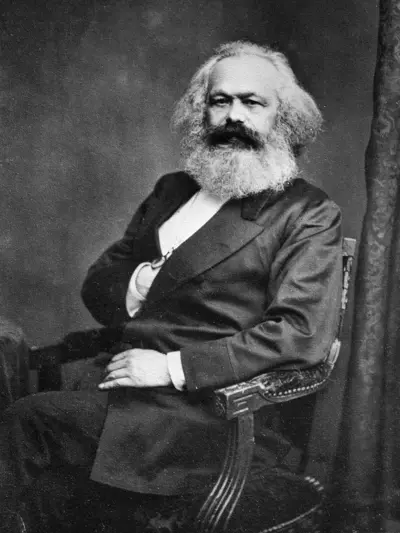
Karl Heinrich Marx was a German philosopher, economist, historian, sociologist, political theorist, journalist and socialist revolutionary. Born in Trier, Germany, Marx studied law and philosophy at university. He married Jenny von Westphalen in 1843. Due to his political publications, Marx became stateless and lived in exile with his wife and children in London for decades, where he continued to develop his thought in collaboration with German thinker Friedrich Engels and publish his writings, researching in the reading room of the British Museum. His best-known titles are the 1848 pamphlet The Communist Manifesto and the three-volume Das Kapital (1867–1883). Marx's political and philosophical thought had enormous influence on subsequent intellectual, economic and political history. His name has been used as an adjective, a noun, and a school of social theory.
