Adam Smith Quotes
The sneaking arts of underling tradesmen are thus erected into political maxims for the conduct of a great empire; for it is the most underling tradesmen only who make it a rule to employ chiefly their own customers. A great trader purchases his good always where they are cheapest and best, without regard to any little interest of this kind.
Smith, Adam. An Inquiry into the Nature and Causes of the Wealth of Nations. W. Strahan and T. Cadell, 1776.


5th Earl of Rosebery. With free trade, there are winners and losers. The advocates observe that overall, there is a great benefit to most countries engaging in free trade, but some sectors of the economy, and some areas and groups of people fare poorly.


In October 2025 (ahead of ongoing trade negotiations), the Ontario Provincial Government (Canadian) produced a video ad distributed in the US using a voice-over of the above quote from a 1987 Ronald Reagan Presidential Radio Address. The ad uses five complete sentences from the five-minute weekly address, but they are spliced together out of sequence. Also, while the ad implies Reagan was against tariffs, it omitted the context that he was using the radio address to announce new tariffs imposed on Japan by his administration but that they should be seen as an unavoidable exception to his basic belief in free trade as the key to prosperity. He said, “our commitment to free trade is also a commitment to fair trade.” President Trump accused the Ontario government of producing a fraudulent ad and of attempting to influence the US Supreme Court as it prepares to hear arguments about the legality of Trump’s tariffs. As a result, the Trump administration terminated trade negotiations with Canada.
Statement made during a speech announcing tariffs on Japan who had violated semiconductor trade agreements with the US.
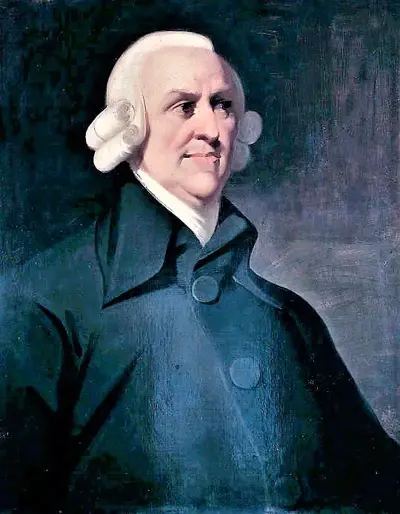
Adam Smith FRSA was a Scottish economist, philosopher as well as a moral philosopher, a pioneer of political economy, and a key figure during the Scottish Enlightenment, also known as ''The Father of Economics'' or ''The Father of Capitalism''. Smith wrote two classic works, The Theory of Moral Sentiments (1759) and An Inquiry into the Nature and Causes of the Wealth of Nations (1776). The latter, often abbreviated as The Wealth of Nations, is considered his magnum opus and the first modern work of economics. In his work, Adam Smith introduced his theory of absolute advantage.
