Oliver Stone Quotes
The second [presidential] term changes, and I think that John F. Kennedy certainly ran on that and he knew that second term would give him oxygen, and he needed it. Unfortunately, he didn't get there.
Stone, Oliver. Interview. The Hollywood Reporter, 2013.


In the original constitution there was no limit to the number of 4 year terms the President could serve. By the 1840’s there was much concern that a President could even serve 2 terms and there was a movement to limit the presidency to one term of which Harrison was a leading proponent. His death and short time in office, ended that initiative. . There was an “unwritten” rule that presidents would only serve at most two terms until TR tried for a 3rd but failed only because of a rigged Republican convention. After FDR was elected to 4 consecutive terms, the Republicans pushed through the 22nd Amendment limiting the President to two terms. The irony was that the first president that was affected by the new standard was Republican Eisenhower who probably could have won a 3rd term. Then Ronald Reagan could probably have won a third term even though he was already suffering from Alzheimer’s disease in his second term. Democrat William Clinton could also have likely won a third term were it not for the 22nd Amendment.

Reagan, Ford, Nixon, Clinton


In 1980 Russian troops moved into Afghanistan, and President Jimmy Carter imposed an American grain export embargo against Russia:

This proposal is amazingly close to where we have ended up after the Constitutional amendment limiting the President to two 4 year terms. Mason’s reasoning however was very different. He assumed that the legislature would elect the President.


Hamilton thought that the Executive Branch should be co-equal with the Judicial Branch and lifetime tenure should apply to both. This quotation is very important as we consider developing countries and emerging democracies. Some in the third world have Presidents for Life—a concept that most democracies scoff at. But the stability and the independence was important enough to some of the Founding Fathers was actually advocated and considered as we formed the American Democracy.

The President’s party in Congress stands election every two years, so the president only has a little more than a year to get tough things done. The mayor, in contrast, had a four term and because he was a bipartisan independent representing both parties, didn’t need to campaign for his party members on the City Council. Therefore, he thought, that it was easier for him to take a controversial position and spend the time to persuade the people and build support for the position.

This quotation perhaps was the most critical in Roosevelt’s political career. After winning the presidential election in his own right, that evening at a press conference he called, he not only committed to serving only two terms—then a custom and not law as it would be after WWII—but he also committed that his first three and a half years where he was not elected but assumed the presidency upon McKinley’s assassination would count as a full elected term. He therefore in 1908 could not run again even though the public wanted him to, and he might have liked another term. More important historically was 1912. Roosevelt had chosen his close friend and colleague William Howard Taft to succeed him and with Roosevelt’s support he was elected in 1908. But Taft’s wife who had always been his closest political advisor and reviewer of all his policies and speeches, had a stroke shortly after Taft was elected. Taft’s performance as President was very disappointing to Roosevelt, and he ran against Taft in the 1912 Republican nominating campaign. The very conservative Republicans were against Roosevelt, but many of those who liked him were distressed that he was reneging on his pledge not to run for a 3rd term. Roosevelt lost, and famously started the Bull Moose Party and ran against Taft and Wilson. He outpolled Taft but with the split Republican vote, Woodrow Wilson won the Presidency. This pledge haunted Roosevelt for the rest of his life.


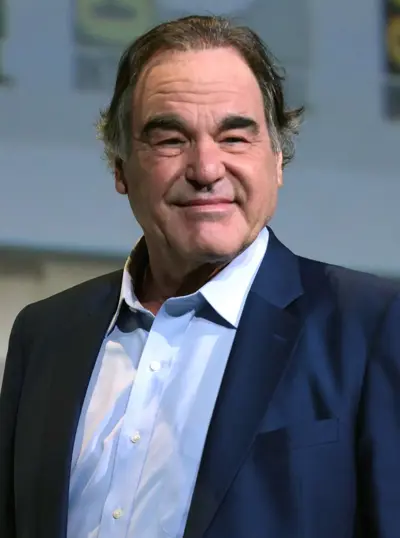
William Oliver Stone is an American film director, producer, and screenwriter. Stone won an Academy Award for Best Adapted Screenplay as writer of Midnight Express (1978), and wrote the gangster movie remake Scarface (1983). Stone achieved prominence as writer and director of the war drama Platoon (1986), which won Academy Awards for Best Director and Best Picture. Platoon was the first in a trilogy of films based on the Vietnam War, in which Stone served as an infantry soldier. He continued the series with Born on the Fourth of July (1989)—for which Stone won his second Best Director Oscar—and Heaven & Earth (1993). Stone's other works include the Salvadoran Civil War-based drama Salvador (1986); the financial drama Wall Street (1987) and its sequel Money Never Sleeps (2010); the Jim Morrison biographical film The Doors (1991); the satirical black comedy crime film Natural Born Killers (1994); a trilogy of films based on the American Presidency: JFK (1991), Nixon (1995), and W. (2008); and Snowden (2016).
