William Kingdon Clifford Quotes
The scientific discovery appears first as the hypothesis of an analogy; and science tends to become independent of the hypothesis.
Clifford, William Kingdon. "The Philosophy of the Pure Sciences." Lectures and Essays, edited by Leslie Stephen and Frederick Pollock, vol. 1, Macmillan and Co., 1879, pp. 254-340.


This quotation is used by some of those demonstrating that “Creation Science” is not science, as it is a set of facts, with no experimental verification.

This quotation is important for politicians who appropriate research funds. There are many, important, significant, scientific findings, that are inherent to what we already know, but needs the scientific person-power and time to “work it out.”

This quotation illustrates and important aspect of science. Specifically, that theory, something ephemeral and impractical to the layman, has immense practical power in developing great scientific and technological breakthroughs. The result of this breakthrough was large lenses that could make lights more powerful and make lighthouses much more safe. Even the atomic bomb was really developed from theory and then engineered for practical use.


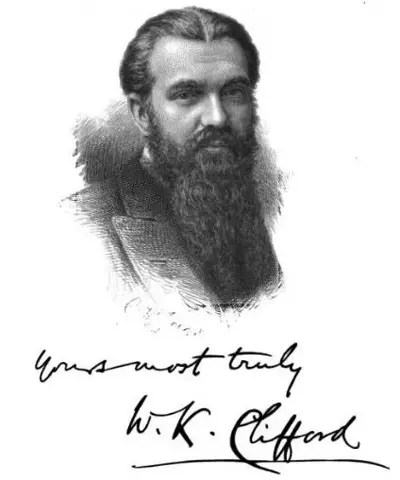
William Kingdon Clifford FRS was an English mathematician and philosopher. Building on the work of Hermann Grassmann, he introduced what is now termed geometric algebra, a special case of the Clifford algebra named in his honour. The operations of geometric algebra have the effect of mirroring, rotating, translating, and mapping the geometric objects that are being modelled to new positions. Clifford algebras in general and geometric algebra in particular have been of ever increasing importance to mathematical physics, geometry, and computing. Clifford was the first to suggest that gravitation might be a manifestation of an underlying geometry. In his philosophical writings he coined the expression mind-stuff.
