Frederick the Great Quotes
The Saracens … since they hold the temple in great veneration, may come there as often as they choose in the character of pilgrims, to worship according to their custom, and … we shall henceforth permit them to come, however, only as many as we may choose to allow, and without arms, nor are they to dwell in the city, but outside, and as soon as they have paid their devotions they are to depart.
the Dome of the Rock and the Al-Aqsa Mosque
Frederic II, 1194-1250, Holy Roman Emperor & King of Jerusalem, Leader of the 6th Crusade, Letter to Henry III, King of England, 1229
Sourced by: Eigen's Political and Historical Quotations


In the rest of the Islamic world, the call to prayer was said in Arabic regardless of the national language. This reform was castigated by throughout the Islamic world who wanted Arabic to be the only language for Muslim religious communications. This was not unlike the insistence that they Catholic Church had maintained that all scripture was read in Latin and would not allow Bibles or mass to be said in any other language.


Madison was a deist, but was firm that religion was to be an individual matter and not an area in which the state ought be involced.
There is irony in this act and statement. The film was censored because it was a defamation to Jesus Christ, who the Muslims recognize as a holy Prophet. See {620971} . However, ultra-fundamentalist Muslim clerics preach hate and desecration of Christianity, Judiasm, and Hinduism commonly. None are ever prosecuted in Pakistan. Books and pamphlets excoriating Christian, Jewish, Hindu and Bhai prophets are common place in Pakistan. Ironically, this banned film was called for by the Catholic Church.


In one of the historical ironies of the 12th century, a Christian sect preferred the rule of the Muslims than their Christian brethren—on the grounds of religious tolerance. It illustrates the changes that take place over time. By the 21st century, it was the Christians who were thought of as tolerant and the Muslims as the opposite.


At the time Turkey was the only Muslim majority country where there was coexistence with secularism but with Christians and Jews as well. Ataturk, the great Turkish leader, turned Turkey around, modernized it, Westernized it, and made it a secular state with freedom of Religion, much like the United States. However, Erdogan’s party was constantly trying to make the state more Islamic as his electoral base were the poor, religious, Muslims.

The Barbary Pirates of Algiers, led and controlled by the Bey or Dey (king) had an incredible extortion racket going in the Mediterranean. If nations would pay them an annual sum each year, they would not attack and seize merchant ships of that country and sell the ships and goods while holding the sailors for ransom. The only thing that the Algerians seemed to be interested in was money and religion.
The Ataturk reforms modernized Turkey and turned it into the most modern and democratic of the Islamic countries. However, there were always forces and populist governments that tried to erode the Ataturk reforms—especially secularism.

He is a Greek Orthodox Christian, and he correctly observes that the Islamic world was considerably more tolerant than the Christian until the 18th century when Islam had become less tolerant in the Middle East while the Christians were modernizing and going through a cultural and intellectual enlightenment and societal modernization while the Muslims, became less tolerant than they were in earlier years leading to the modern situation.
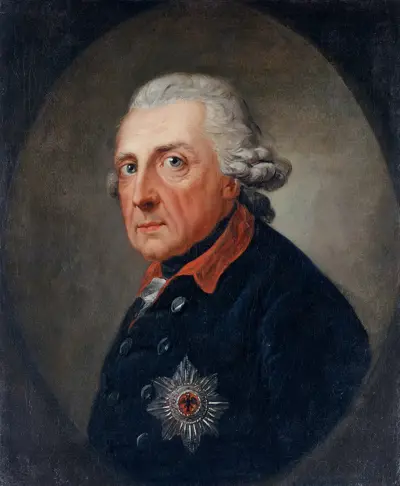
Frederick II was a Prussian king and military leader who ruled the Kingdom of Prussia from 1740 until 1786, reigning longer than any other Hohenzollern king. His most significant accomplishments during his reign included his reorganization of Prussian armies, his military successes in the Silesian wars and the Partitions of Poland, and his patronage of the arts and the Enlightenment. Frederick was the last Hohenzollern monarch titled King in Prussia and declared himself King of Prussia after annexing strategic parts of the Polish–Lithuanian Commonwealth in 1772. Prussia greatly increased its territories and became a leading military power in Europe under his rule. He became known as Frederick the Great (German: Friedrich der Große) and was nicknamed "The Old Fritz" (German: "Der Alte Fritz") by the Prussian people and eventually the rest of Germany.
