Roger Curtis Quotes
The ruling Passion of the Dutchman is Avarice. Of literature they know nothing, and they are seldom seen with a book.
The “Dutchman” referred to the Boer population of South Africa. See {583922} for a Dutch similar assessment and {583929} for another similar Engish view.
Roger Curtis, 1746-1816, English Admiral, Journal,~1797
Sourced by: Eigen's Political and Historical Quotations

The Boers, the early Dutch settlers to South Africa were a “scurvey lot” who were very uneducated, narrow minded, and insular. They eventurally esterminated whole tribes of Blacks, caused the Boer War, and operated the disasterous apartheid era of South Africa. But the early Dutch governors of South Africa had great trouble with the Boers as well. See {583928} & {583928} for English similar assessments.

See {583928} and {583922}
There was continuing tension between England, the Colonial Governors of South Africa and the Boers. Immigrant settlers to South Africa from Holland. The Boers were very uneducated and not steeped in democratic government. They wanted to enslave and sieze the land of the Black residents. Under English law, the Blacks were also English subjects. The Boers insisted that any interference in their persecution and enslavery of the Blacks was oppression just as the Southern American Whites saw Reconstruction defense of the Blacks as oppression to them. The classic question is: “Is it oppression to stop people from opressiong others?”


When the British first colonized South Africa, the area they used was akmost uninhabited or very sparcely so. However, some Black tribes (including the Zulus) were moving from the north and themselves were colonizing or annexing the areas to their kingdom. The British were most interested in Trading so did not have large land asperations. The Dutch white Boer Africanners, in contrast, wanted to farm the lands and use the range for their cattle. They wanted the land. The English policy was that there would be friendly relations with the Black tribes surrounding their Cape Colony and no one should take their land. However the Boers started attacking the Black areas and seizing their farms and villages. At first, the English assumed that the Blacks would easily be able to ward off the invasion as the Afrikanners had no professional troops like the British. However, the neighboring tribes were not very warlike or good fighters. They were being overrun by the Zulus coming from the North and the Boers from the South. The British Government had a real problem in that they would have to have British soldiers fight the white Afrikanners if they wanted to stop the illegal white invasions. This was the root of the Boer War where the British would be fully at war with the Africanners.
When the British first colonized South Africa, the area they used was not inhabited or very sparcely so. However, some Black tribes (including the Zulus) were moving from the north and themselves were colonizing or annexing the sparcely populated areas to their kingdom. The British were most interested in Trading so did not have large land asperations. The Dutch white Boer Africanners, in contrast, wanted to farm the lands and use the range for their cattle. They wanted the land. The English policy was that there would be friendly relations with the Black tribes surrounding their Cape Colony and no one should take their land. However the Boers started attacking the Black areas and seizing their farms and villages. At first, the English assumed that the Blacks would easily be able to ward off the invasion as the Afrikanners had no professional troops like the British. However, the neighboring native tribes were not very warlike or good fighters. They were being overrun by the Zulus coming from the North and the Boers from the South. The British Government had a real problem in that they would have to have British soldiers fight the white Afrikanners if they wanted to stop the illegal white invasions. This was the root of the Boer War where the British would be fully at war with the Africanners.
The White Africaners were attacking the Blacks to force them off their land so the Afrkaners could take over. The country was under British rule and the unarmed Blacks were being slaughtered by the Afrikaners who were British Subjects. Eventually the Boer War set the English against the Afrikaners. See {583902} for a related quotation.


Then, as today, whenever a person was greedy rich, people might not approve of their ethics or morals, but the assumption was (not always warranted) that the person was smart and wise in the ways of making money, and very often people would generalize to other areas and think the money maker was generally sagacious.

Samuel Langhorne Clemens, 1835-1910


President Theodore Roosevelt referred to the same groups similarly. See {638453} and {639956}.

Roosevelt believed that the person who just made money was sorely lacking and he had a duty to the society and the country that went beyond money. Much of the upper class though him a prig and resented his criticism.


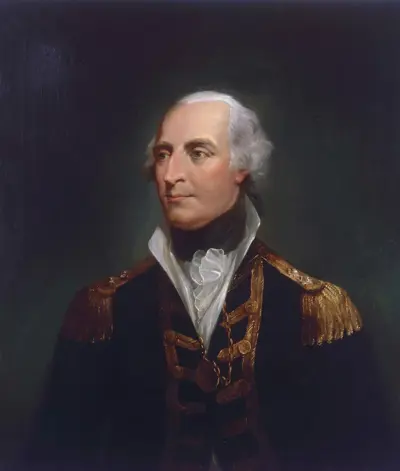
- Born: June 4, 1746
- Died: November 15, 1816
- Nationality:
- Profession:
Admiral Sir Roger Curtis, 1st Baronet, GCB was an officer of the British Royal Navy, who saw action in several battles during an extensive career that was punctuated by a number of highly controversial incidents. Curtis served during the American Revolutionary War and the French Revolutionary Wars and was highly praised in the former conflict for his bravery under fire at the Great Siege of Gibraltar, where he saved several hundred Spanish lives at great risk to his own. His career suffered however in the aftermath of the Glorious First of June, when he was heavily criticised for his conduct by several influential figures, including Cuthbert Collingwood. His popularity fell further due to his involvement in two highly controversial courts-martial, those of Anthony Molloy in 1795 and James Gambier in 1810.
